
BTEC Public Services assignment help covers Level 3 National Public Services across all pathway areas, uniformed services including police, fire, ambulance and the armed forces, as well as non-uniformed public sector roles in civil service, local government, and NHS. The qualification is assessed entirely through internal coursework at National level, with units covering government and politics, citizenship and diversity, discipline and physical fitness, crime and its effects, and the operational context of specific services. Distinction in BTEC Public Services requires moving beyond describing legislation and service procedures to evaluating their effectiveness, impact, and the tensions between competing public sector values. This service provides criterion-specific guidance at the level each unit demands.
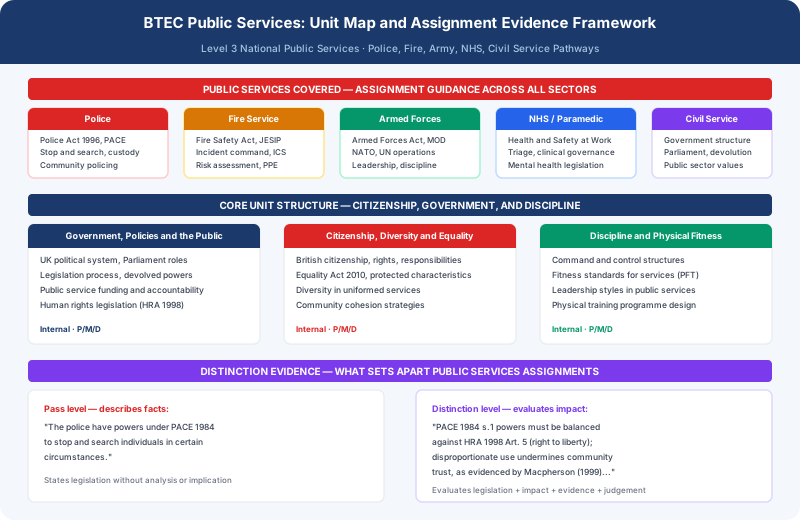
BTEC National Public Services: Unit Structure and Core Content Areas
BTEC National Public Services is available as an Extended Certificate (360 guided learning hours, one A-level equivalent), a Diploma (720 guided learning hours), and an Extended Diploma (1,080 guided learning hours). It is studied predominantly by post-16 students at further education colleges who are preparing for careers in uniformed and non-uniformed public services, though it also serves as a route to higher education in public services management, criminology, or social policy.
Assessment at BTEC National Public Services is entirely internal, all units are tutor-set, centre-marked, internally verified, and Pearson-moderated. There are no external examinations at this level in Public Services, which means every unit carries a resubmission option if the initial submission receives a Referral. This makes careful pre-submission criterion checking particularly important, as a first-attempt Distinction is achievable on every unit.
Core units across most BTEC National Public Services programmes include: Government, Policies and the Public Services (the structure of UK government, Parliament, the legislative process, devolved administrations, and the relationship between public services and government policy); Citizenship, Diversity and the Public Services (British citizenship, rights and responsibilities, the Equality Act 2010, diversity strategies in public service organisations); Physical Preparation, Health and Wellbeing for the Public Services (physical fitness components, fitness testing, training programme design, and the fitness standards required by different services); and Crime and its Effects on Society (causes of crime, criminal statistics, criminal justice system processes from arrest through sentence).
Optional units extend coverage to more service-specific content: patrol operations, military investigations, public service skills, first aid, expedition and outdoor activities, and leadership in the public services. The range of optional units means different students at different centres may have substantially different unit portfolios even within the same qualification title.
Government, Policies and the Public Services: Assignment Help and Grading Standards
The Government, Policies and the Public Services unit is one of the highest-value and most intellectually demanding units in BTEC National Public Services. It requires students to demonstrate understanding of the UK constitutional framework, the legislative process, the structure and role of Parliament, the functions of devolved assemblies, and the mechanisms by which government policy is translated into public service obligations and operations.
Pass criteria require accurate descriptions of the UK political system: the role of the monarch, the House of Commons, the House of Lords, the Cabinet, the Prime Minister, government departments and ministers, the legislative process (Green Paper, White Paper, Bill, Act of Parliament), and the devolved assemblies of Scotland, Wales, and Northern Ireland with their respective reserved and devolved powers. A common Pass failure is an incomplete or inaccurate description of the legislative process, students describe bills becoming law without explaining the role of both Houses or the Royal Assent stage.
Merit criteria require analysis of how government policy affects public service operations. This means tracing the pathway from a policy decision to its operational impact on a specific service. For example, the Policing and Crime Act 2017's reform of police accountability structures changed how Police and Crime Commissioners interact with chief constables, a Merit analysis explains the specific mechanism of that policy impact on the operational independence of police leadership, not merely that "government policy affects the police."
Distinction criteria require evaluation of government policy effectiveness in the public service context. This involves assessing whether policy objectives have been achieved, identifying unintended consequences, examining the tensions between government policy and public service operational independence, and making a justified assessment of policy outcomes. Using evidence from official reports (National Audit Office reports, HMIC inspection findings, parliamentary select committee reports) demonstrates the evaluative engagement Distinction requires, and distinguishes the response from one that is merely well-informed about policy content.
Citizenship, Diversity and Equality in BTEC Public Services: Distinction-Level Analysis
Citizenship, Diversity and the Public Services is a unit that consistently generates wide variation in student performance, because students who know the Equality Act 2010 thoroughly still frequently produce only Pass-level responses by describing protected characteristics rather than analysing the structural challenges of diversity in uniformed services and evaluating the effectiveness of diversity strategies.
The nine protected characteristics under the Equality Act 2010 must be known and applied correctly: age, disability, gender reassignment, marriage and civil partnership, pregnancy and maternity, race, religion or belief, sex, and sexual orientation. Pass criteria require identifying and describing these characteristics, describing the types of discrimination prohibited (direct discrimination, indirect discrimination, harassment, victimisation), and explaining the legal obligations on public service employers under the Act including the Public Sector Equality Duty (s.149).
Merit criteria require analysis of how public services have approached diversity, examining specific diversity initiatives, recruitment strategies, and organisational culture changes in named services (the Metropolitan Police's diversity recruitment targets, the fire service's Women in the Fire Service programme, the armed forces' repeal of the ban on transgender service personnel). The analysis must explain the mechanisms by which initiatives are intended to address underrepresentation or discrimination, not merely describe that they exist.
Distinction criteria require critical evaluation of diversity strategies and their outcomes. Key tensions to evaluate include: the conflict between positive action measures and perceptions of merit-based selection; the gap between policy intent and cultural change in traditionally masculine uniformed services; the evidence from HMIC, HMICFRS, or parliamentary reports on whether diversity targets have been achieved; and the residual organisational culture barriers that policy alone cannot address. The MacPherson Report (1999) and subsequent HMIC reports on institutional practices provide the evidential basis for a Distinction-level evaluation in this unit.
Crime and Its Effects: Criminal Justice System Assignments for BTEC Public Services
The Crime and its Effects unit covers the nature, measurement, and causes of crime, the criminal justice system from arrest through sentencing, and the impact of crime on individuals, communities, and public services. It is a theoretically rich unit with multiple competing criminological frameworks that must be applied and evaluated at Merit and Distinction level.
Pass criteria require: definitions and examples of different crime categories (violent crime, acquisitive crime, drug-related crime, cybercrime, organised crime, hate crime); an explanation of how crime is measured in England and Wales, the Crime Survey for England and Wales (CSEW) and police-recorded crime statistics, their differences, and what each measures; and a description of the criminal justice process from the point of arrest (police powers, arrest, custody rights under PACE 1984, charge, court appearance, sentencing).
Merit criteria require analysis of the causes of crime using criminological theory. The major theoretical frameworks include: biological theories (Lombroso's criminal type, contemporary neurobiological and genetic research); psychological theories (Eysenck's theory of criminality, social learning theory); sociological theories (strain theory: Merton; subcultural theory: Cohen; labelling theory: Becker; social control theory: Hirschi; left realism: Lea and Young; right realism: Wilson and Kelling's broken windows). Merit analysis applies the appropriate theory to the type of crime being analysed and explains the mechanism of causation the theory proposes.
Distinction criteria require evaluation of criminological theories: which theories best explain different types of crime, where do they fail, and what is the empirical evidence for and against each? The Distinction standard requires acknowledging that no single theory explains all crime, that theories have ideological assumptions embedded within them, and that the evidence base for criminological theories is contested. Official statistics are socially constructed measures, not objective counts, evaluating the limitations of crime measurement data is itself a Distinction-level analytical task.
Physical Fitness for Public Services: Training Programme and Fitness Assessment Help
Physical Preparation, Health and Wellbeing units in BTEC Public Services require students to design and justify fitness training programmes specifically targeted at preparing for the physical selection and in-service fitness requirements of named public services. This is distinct from generic sport science fitness programming, the context is professional fitness standards, not athletic performance.
Students must know the specific fitness standards for their chosen services: the Police Service requires the Chester step test (bleep test equivalent) at the minimum 5.4 shuttle level; the Fire and Rescue Service requires the physical competencies assessed in the PFST (Physical Fitness Selection Test) including a casualty drag, ladder extension, and enclosed spaces test; the British Army requires the Army Fitness Assessment (AFA) with gender- and age-adjusted standards for the 2km run, press-ups, and sit-ups.
Pass criteria require: a fitness testing battery appropriate to the service requirements, with results compared against service-specific standards rather than generic normative data; identification of the fitness components most relevant to that service (cardiovascular endurance, muscular strength, muscular endurance, flexibility, power); and a training programme applying the FITT principle to each fitness component targeted.
Merit criteria require analysis: why are these fitness components most important for the operational requirements of this service? How has the training programme been designed to progressively overload each component? Distinction criteria require evaluation: critically assess the fitness test results against service standards, identify whether the candidate is currently capable of meeting entry requirements, prioritise training needs with evidence-based justification, and evaluate the programme against the principles of training (SPORT and FITT), identifying where constraints such as time availability affect the programme's optimal design.
Leadership, Teamwork, and Self-Management Evidence in BTEC Public Services
Leadership and teamwork units are among the most practically oriented in BTEC National Public Services — they require both theoretical knowledge of leadership and team development models and evidence of applying those models to real or simulated professional public service contexts. Self-management evidence (reflective logs, personal development plans, fitness testing records) forms a significant part of the portfolio for students preparing for service entry applications.
Leadership theory in a public services context: three leadership models are most commonly assessed in BTEC Public Services assignments. Transformational leadership (Burns, 1978; Bass, 1985) describes leaders who motivate followers through vision, intellectual stimulation, and individual consideration — evaluated in public service context by assessing whether a described leader's approach achieves organisational change, sustains staff motivation during reform periods, or develops the next generation of officers. Situational leadership (Hersey and Blanchard) argues that effective leaders adapt their style to the readiness and competence of their followers: a Directing style (high task focus, low relationship focus) for new recruits who need clear instruction; a Coaching style (high task, high relationship) for developing officers who have some competence but need guidance; a Supporting style (low task, high relationship) for experienced staff who are competent but may need motivation; a Delegating style for high-competence, high-commitment personnel who can work autonomously. Command leadership — the rank structure, clear chain of command, and unambiguous authority relationships that characterise the police, fire service, and armed forces — provides the dominant leadership model in uniformed services; Distinction requires evaluating its advantages (speed of decision-making, role clarity, accountability) alongside its limitations (inhibited initiative, inappropriate for complex community engagement, poor fit for multi-agency collaboration that requires horizontal rather than hierarchical relationships).
Teamwork models: Tuckman's five-stage model (Forming — group establishes itself, low productivity; Storming — conflict over roles and authority; Norming — agreement on norms and roles, trust developing; Performing — high productivity and cohesion; Adjourning — group dissolution) describes how teams develop over time. Merit application involves analysing which stage a described group has reached, explaining the indicators, and identifying what leadership intervention is appropriate for that stage. Distinction requires evaluating the model's limitations — not all teams progress linearly through the stages, some skip stages or regress, and the Adjourning stage was added by Tuckman retrospectively in 1977. Comparing Tuckman's temporal model with Belbin's role-based model (which describes complementary functional roles rather than developmental stages) demonstrates the analytical depth Distinction requires: Belbin's nine team roles — Plant (creative problem-solving), Resource Investigator (external networking and opportunity identification), Co-ordinator (goal-focused facilitation, clarifying roles), Shaper (drive and challenge), Monitor Evaluator (critical analysis, weighing options without bias), Teamworker (collaborative support, preventing friction), Implementer (practical organisation and follow-through), Completer Finisher (quality control and deadline management), and Specialist (expert technical knowledge) — provide the framework for analysing a team's functional strengths and the capability gaps that may explain poor performance.
Self-management evidence formats: reflective logs from physical training activities, drill exercises, patrol simulations, or fieldwork provide the evidence base for professional development portfolios. A Pass-level reflective log records what happened. Merit-level reflection connects the experience to leadership or teamwork theory — explaining how the interaction demonstrated a specific Tuckman stage, or how the leadership approach used matched or mismatched the situational leadership model's recommendation for the group's readiness level. Distinction-level reflection evaluates the professional development implications — identifying the specific competency gap the experience revealed, designing a SMART personal development plan to address it, and selecting preparation strategies explicitly referenced to service entry competency frameworks (police SEARCH assessment, fire service PFST preparation, armed forces BARB test preparation). Physical fitness testing logs should record test dates, results against service-specific standards (Police: Chester step test minimum 5.4 shuttles; Fire and Rescue: PFST casualty drag, ladder extension, enclosed spaces; British Army: AFA gender/age-adjusted 2km run, press-ups, sit-ups), training priorities identified, and a progressive programme applying FITT principles to close the identified gap.
What is the key distinction between a good Merit and a Distinction in BTEC Public Services assignments? Merit analysis explains how and why, how legislation affects operations, why a policy was introduced, how a service responds to a community need. Distinction evaluates the evidence: does the policy achieve its objective, what are the unintended consequences, where does the evidence support a different approach? A Distinction response takes a position and defends it with evidence; a Merit response explains both sides without reaching a justified conclusion.
Progression from BTEC Public Services: Higher Education and Service Entry
BTEC National Public Services Extended Diploma is accepted by UK universities for entry to undergraduate programmes in criminology, policing, public services management, security management, and social policy. The UCAS tariff at D*D*D is 168 points, equivalent to three A* grades. Universities offering criminology and policing degrees, including those with police degree apprenticeship pathways, regularly accept BTEC Public Services as meeting subject requirements.
For direct service entry alongside or after BTEC National, the qualification provides a strong foundation of procedural and theoretical knowledge that supports the application and selection processes used by police forces (SEARCH assessment), fire services (competency-based selection), and the armed forces (BARB test and service entry selection). The BTEC portfolio evidences the commitment and knowledge expected of candidates entering public service.
For related guidance: BTEC National assignment help, BTEC grading criteria explained, and How to achieve Distinction in BTEC assignments.
Does BTEC National Public Services have any external examinations?
BTEC National Public Services is assessed entirely through internal coursework, there are no Pearson-set external examinations at National level in this subject. All units are tutor-set, centre-marked, internally verified, and Pearson-moderated. One resubmission is available for each unit if the initial submission receives a Referral. Students should verify their specific programme with their centre, as qualification structures can vary.
What legislation is most important for BTEC Public Services assignments?
Key legislation varies by unit, but across the qualification students most commonly need: Police and Criminal Evidence Act 1984 (PACE), police powers, arrest, custody, evidence; Equality Act 2010, protected characteristics, public sector equality duty; Human Rights Act 1998, rights in the European Convention; Children Act 1989 and 2004, safeguarding; Crime and Disorder Act 1998, partnership working; Health and Safety at Work Act 1974, operational risk management. The Assignment Brief for each unit will specify the legislation relevant to that assessment.
How do I write at Distinction level for a government and politics unit in BTEC Public Services?
Distinction in government and politics units requires evaluating policy effectiveness, not just describing policy content. Use evidence from official reports: National Audit Office reports, HMICFRS inspection findings, parliamentary select committee reports, ONS statistics, to make a justified assessment of whether a policy has achieved its stated objectives. Identify tensions: between central government direction and local service operational independence, between austerity-driven resource constraints and service demand, between political objectives and professional public service values. Reach a justified conclusion with a defended position.
Which criminological theories are most important for BTEC Public Services crime units?
Core criminological theories for BTEC Public Services crime units include strain theory (Merton), subcultural theory (Cohen), labelling theory (Becker), social control theory (Hirschi), broken windows theory (Wilson and Kelling), left realism (Lea and Young), and social learning theory (Sutherland's differential association). At Merit level, apply the theory that best explains the crime type being analysed. At Distinction level, evaluate competing theories, identifying the strengths and limitations of each and reaching a justified position on which provides the most convincing explanation, with reference to empirical evidence.
Need expert help with your ATHE assignment?
Get Help NowCommon Questions
Is this service specific to BTEC qualifications?
Yes. We specialise exclusively in Pearson BTEC qualifications. Our writers are selected for their specific knowledge of BTEC units, marking criteria, and grade descriptors — not generic academic writing.
Will my assignment be plagiarism free?
Every assignment is written from scratch and run through Turnitin before delivery. You receive a copy of the originality report alongside your completed work.
How quickly can you complete my assignment?
Standard turnaround is 5–7 days. For urgent orders we offer 24-hour and 48-hour expedited delivery at an additional cost. Contact us to confirm availability for your deadline.
What if I'm not happy with the work?
We offer unlimited free revisions within 14 days of delivery. If we cannot meet your requirements after multiple revisions, we offer a full refund — no questions asked.