BTEC Sport assignment help covers Level 3 National Sport, Level 4 HNC Sport, and Level 5 HND Sport and Exercise Science across anatomy and physiology, fitness training, coaching, performance analysis, psychology, and nutrition units. Sport is one of the highest-volume BTEC subjects in the UK, and its assessments combine an externally examined anatomy and physiology unit with a portfolio of internal coursework assignments that require application of sport science theory to practical sport contexts. The grade boundary between Merit and Distinction in BTEC Sport is the depth of evaluative engagement with sport science evidence, whether the student justifies a position or merely presents both sides. This service provides criterion-specific guidance at all three levels.
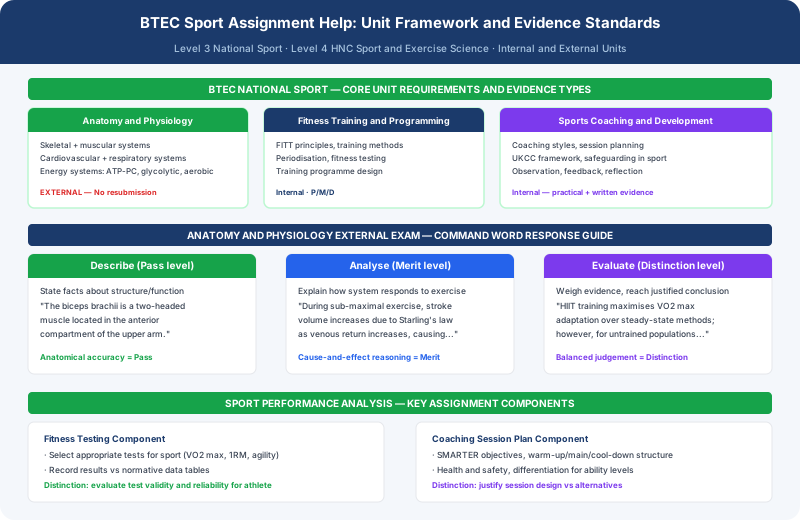
BTEC National Sport: Core Unit Structure and Assessment Types
BTEC National Sport is available as an Extended Certificate (360 guided learning hours, one A-level equivalent), a Diploma (720 guided learning hours), and an Extended Diploma (1,080 guided learning hours, three A-level equivalent). Most students studying BTEC National Sport are in full-time further education at Level 3, pursuing progression to sports coaching, sport science degree programmes, physical education teaching, or health and fitness careers.
Anatomy and Physiology for Exercise and Sport is the externally assessed unit on most BTEC National Sport qualification sizes. It is a Pearson-set, Pearson-marked written examination with no resubmission. Content covers the skeletal system, the muscular system, the cardiovascular system, the respiratory system, and the energy systems (ATP-PC system, anaerobic glycolytic system, and aerobic oxidative system). Students must not only describe these systems but apply them to exercise scenarios, explaining how each system responds to different exercise intensities and durations.
Internally assessed units include: Fitness Training and Programming (FITT principle, training methods, periodisation, fitness testing battery selection and analysis); Sports Coaching (coaching styles, session planning, observation and feedback techniques, safeguarding in sport, the UKCC framework); Sports Performance Analysis (match analysis methodology, notation systems, statistical analysis of performance data, individual and team performance profiling); and Sports Psychology (arousal, anxiety and performance: Inverted-U theory, catastrophe theory; motivation, goal-setting, concentration, and confidence). Each of these units carries the standard one-resubmission rule.
Anatomy and Physiology External Exam: What BTEC Sport Students Must Know
The Anatomy and Physiology external examination is the most consequential unit in BTEC National Sport, it carries significant credit value, it cannot be resubmitted, and its command word requirements are systematically different from the coursework approach students use for internal units. Treating it as an extension of coursework preparation is the most common cause of underperformance.
The examination uses stimulus material, typically a scenario about an athlete's training programme or performance context, and structured questions that increase in demand from Pass to Distinction level. The command words used in exam questions must be matched exactly: "Describe" requires a factual, accurate account without analytical content; "Analyse" requires cause-and-effect reasoning linked to the sporting context in the stimulus; "Evaluate" requires weighing evidence on both sides and reaching a supported conclusion.
For energy systems questions, students must know the three energy systems' sources (PCr, glucose/glycogen, fat and glucose), time frames (ATP-PC: 0–10 seconds; glycolytic: 10 seconds–2 minutes; aerobic: 2 minutes plus), limiting factors, and recovery requirements. The Merit standard requires applying the correct energy system to the sport scenario described, explaining why a 100m sprint relies primarily on the ATP-PC system while a marathon relies predominantly on the aerobic system, with reference to the role of oxygen and ATP resynthesis rate. The Distinction standard requires evaluating the relative contribution of energy systems in sports that use mixed intensities, a footballer, for example, uses all three energy systems across a 90-minute match, and recommending appropriate training interventions based on that analysis.
For cardiovascular and respiratory responses to exercise, students must be able to explain the acute responses (increased heart rate, stroke volume, cardiac output, respiratory rate, tidal volume, oxygen extraction) and distinguish these from the chronic training adaptations that occur with regular exercise (cardiac hypertrophy, bradycardia at rest, increased lung capacity, increased capillary density). Confusing acute responses with chronic adaptations is a consistent exam error that reduces responses to Pass level regardless of the student's subject knowledge in other areas.
Fitness Training and Programming: Writing a BTEC Sport Assignment for Distinction
Fitness Training and Programming is one of the most practically oriented units at BTEC National Sport, but it consistently generates referrals because students produce a training programme without the written justification the criteria require. A Distinction in this unit requires not only a well-designed programme but a comprehensive written analysis demonstrating that every element of the programme has been designed with specific evidence-based reasoning.
Pass criteria require: a fitness testing battery appropriate to the sport or client, with results recorded and compared to normative data tables; a training programme that applies the FITT principle (Frequency, Intensity, Time, Type) to a named client or sport; and accurate descriptions of the training methods used (continuous training, interval training, Fartlek, circuit training, plyometrics, resistance training).
Merit criteria require analysis: why was this testing battery selected for this client rather than alternatives? Why is the training intensity set at this level (expressed as percentage of HRmax or 1RM), and what evidence supports this intensity range for the training adaptation being targeted? How has the training programme applied periodisation, if it is a 12-week programme, how are the macrocycle, mesocycles, and microcycles structured, and what is the rationale for the loading pattern?
Distinction criteria require evaluation: critically assess the fitness testing results against normative data to produce a client profile, justify the priority training needs identified from that profile, and evaluate the fitness programme against recognised training principles (overload, specificity, progression, reversibility, variance: SPORT/FITT). Identify where the programme has limitations, for example, where the client's lifestyle constraints mean optimal training frequency cannot be achieved, and recommend evidence-based adaptations. Citing sport science literature (e.g., ACSM guidelines for exercise prescription) rather than relying on textbook-level description meets the sourcing expectation for Distinction at this level.
Sports Coaching Assignment Help: Session Plans and Reflective Practice
Sports Coaching units at BTEC National Sport require students to plan, deliver, and evaluate coaching sessions, producing both a session plan document and a reflective account of coaching practice. The session plan and reflective evaluation are assessed separately against different criteria, and both must meet their respective Pass criteria before higher grade criteria can be considered.
A BTEC Sport coaching session plan must include: SMARTER objectives (Specific, Measurable, Achievable, Realistic, Time-bound, Evaluated, Reviewed) for the session; a three-phase structure (warm-up, main activity, cool-down) with each phase clearly time-allocated; descriptions of activities with coaching points; differentiation strategies for different ability levels within the group; health and safety considerations specific to the session; and equipment required. A session plan that omits differentiation or health and safety considerations will not meet all Pass criteria.
Merit criteria for coaching assignments require analysis of coaching style choices. The recognised taxonomy of coaching styles, autocratic, democratic, holistic, and laissez-faire, should be applied to explain why a particular style was appropriate for the session group (e.g., a more autocratic approach for a large beginner group where safety is paramount; a more democratic approach with experienced players to develop tactical awareness). The analysis should connect to the group's age, experience, ability, and the session objectives.
Distinction criteria require evaluation of the coaching session and its effectiveness: did the session achieve its objectives, and what evidence (observed outcomes, athlete feedback) supports this assessment? Critically evaluate the coaching methods used, what worked well and why, what would be changed in a future session and what is the evidence base for that change? Referencing the UKCC code of practice, safeguarding legislation (Children Act 2004, Working Together to Safeguard Children 2018), and sport-specific governing body guidance demonstrates the professional framework awareness Distinction-level coaching analysis requires.
Sports Performance Analysis: Match Analysis and Statistical Evidence
Sports Performance Analysis units require students to apply systematic observation and analysis methodologies to sporting performance. The core skills assessed include designing notation systems for recording performance data, collecting valid and reliable data across multiple observations, analysing data statistically to identify performance patterns, and communicating findings to coaches and athletes in a form that supports performance development.
Pass criteria require: a valid notation system designed for the specific sport and performance indicators being measured; correctly recorded data from at least two observations (to assess reliability); accurate descriptive statistics (frequency counts, percentages, ratios) presented in tables and charts; and a basic comparative analysis of observations to identify performance patterns. A notation system that lacks clear operational definitions for each performance indicator (so that two observers would record the same event differently) does not produce valid data and will not fully meet Pass criteria.
Merit criteria require analysis of what the performance data reveals: which technical, tactical, physical, or psychological performance indicators are strengths, and which represent development priorities? The analysis must be evidence-based, referencing the numerical data, and must explain the mechanism linking the performance indicator to overall performance outcomes. For example, if the data shows a high number of possession turnovers in a specific zone, the Merit analysis explains why possession loss in that zone is particularly damaging to the team's tactical system.
Distinction criteria require evaluation: critically assess the reliability and validity of the data collection methodology, acknowledge limitations in the analysis (sample size, observer bias, the specific competition context), and produce evidence-based performance development recommendations that are specific, prioritised, and justified. At HND level, referencing peer-reviewed sport science research on performance analysis methodology (such as work by Mike Hughes and Ian Franks on notation analysis) demonstrates the academic engagement Distinction requires.
BTEC Sport HNC/HND: Sports Development, Management, and Research Requirements
BTEC HNC Sport and Exercise Science (Level 4) and BTEC HND Sport (Level 5) extend National-level content into professional sports management, development, and applied research contexts. The qualification structure, academic writing expectations, and Distinction evidence standards change substantially from National level — students transitioning from BTEC National Sport to HNC should expect a significant adjustment in both sourcing requirements and the depth of analytical engagement expected.
HNC Sport (Level 4) unit structure: core units typically include Sports Development (community sport delivery models, National Governing Body policy frameworks, sports participation strategy, UK Sport and Sport England funding structures); Sports Management (facility management, event planning and operations, financial management in sport, staffing and volunteer management); Health-Related Exercise and Fitness (applying ACSM exercise prescription guidelines to specific populations, fitness testing and programme design at professional standard); Research Methods in Sport (quantitative and qualitative research design, sampling strategies, data collection instruments, basic statistical analysis using SPSS or similar software); and Psychology of Sport (arousal-performance relationships: Inverted-U theory, catastrophe theory, and the challenge-threat model; goal-setting theory, concentration strategies, team cohesion models). Harvard referencing is mandatory for all written assignments from Level 4 onwards. Assessors expect in-text citations and a full reference list; substantive claims without citations will not reach Merit or Distinction in analytical and evaluative sections.
HND Sport (Level 5) Research Project: the HND-level mandatory research project — typically titled Sport and Exercise Research Project or a similar research dissertation unit — is equivalent to the Managing a Successful Business Project in other HND pathways. It requires a minimum 5,000-word structured academic report demonstrating independent research competence. The report structure follows academic convention: introduction and rationale for the research (why this question matters, gap in existing literature), literature review drawing on a minimum of 10–15 peer-reviewed sources, research methodology section (design justification, sample characteristics, data collection instruments, ethical considerations), results, discussion that situates the findings within the existing literature, and conclusions with evidence-based recommendations and study limitations acknowledged. Ethics approval from the college's research ethics committee is typically required before primary data collection can begin — confirm this requirement with your programme coordinator before beginning fieldwork.
Academic sourcing for sport science at HNC/HND: peer-reviewed journals accepted as primary evidence sources at Level 4 and above include: Journal of Strength and Conditioning Research, British Journal of Sports Medicine, International Journal of Sport Science, Journal of Applied Sport Psychology, European Journal of Sport Science, Medicine and Science in Sports and Exercise, and International Journal of Sports Physiology and Performance. Professional guidelines from the ACSM (American College of Sports Medicine) and BASES (British Association of Sport and Exercise Sciences) are accepted alongside journal evidence as authoritative practice standards. General sport textbooks provide foundational support but are insufficient alone for Distinction criteria in evaluative sections at Level 4 or above.
Distinction at HNC/HND: the shift from National Distinction (justified evaluative judgement using course materials) to HNC Distinction requires the same evaluative operation — weighing evidence and reaching a justified position — but supported by published peer-reviewed research. At HND Level 5, Distinction requires engaging with conflicting research: acknowledging where the evidence base on a sport science question is contested (for example, the debate on post-activation potentiation timing, or the conflicting evidence on carbohydrate periodisation for endurance performance), evaluating the methodological quality of the studies cited (sample size, control conditions, ecological validity), and reaching a justified position despite the ambiguity. "The evidence from these studies suggests X is more effective than Y because the RCT evidence (Smith et al., 2021) outweighs the observational data (Jones et al., 2019) given its stronger experimental control" is HND Distinction; "experts say X is generally recommended" is Pass.
What makes a sport science argument reach Distinction in BTEC National Sport assignments? It is not the volume of information, it is the presence of a justified position. Pass presents facts. Merit explains cause and effect. Distinction weighs competing evidence, reaches a reasoned conclusion, and acknowledges the conditions under which that conclusion might not hold. In sport, this means evaluating theories of performance, recommendations for training, or coaching approaches against the specific context of the athlete or sport in the assignment scenario.
BTEC Sport and Sports Science A-Level: University Entry and Career Routes
BTEC National Sport Extended Diploma at D*D*D generates 168 UCAS points, equivalent to three A* grades at A-level. It is accepted by universities for entry to sport science, sports coaching, sports management, physical education, and physiotherapy degree programmes, though Russell Group universities may specify additional A-level requirements. Post-92 universities and specialist sport universities (e.g., Hartpury, Leeds Trinity, St Mary's) regularly accept the BTEC Sport profile for direct entry at degree level.
BTEC HNC Sport and Exercise Science (Level 4) is a standalone Higher National qualification that can also serve as the first year of a degree top-up route. BTEC HND Sport (Level 5) is accepted for top-up entry to the final year of a BSc (Hons) Sport Science or Sport Coaching degree at many universities, offering a more cost-effective route to a degree for students who have completed HNC/HND study at college.
For level-specific guidance: BTEC National assignment help, BTEC HNC assignment help, and How to achieve Distinction in BTEC assignments.
Is the BTEC Sport anatomy and physiology unit externally examined?
Yes. Anatomy and Physiology for Exercise and Sport is an externally assessed unit on most BTEC National Sport qualification sizes. It is a Pearson-set, Pearson-marked written examination with no resubmission. Students who do not achieve a pass must resit in the next Pearson assessment window. The examination uses command words (Describe, Analyse, Evaluate) that require different response types, and preparation requires timed response practice with command word analysis, not only subject knowledge revision.
What energy system knowledge is required for BTEC Sport assignments?
Students must know the three energy systems in detail: the ATP-PC (phosphocreatine) system for explosive activities lasting up to 10 seconds; the anaerobic glycolytic system for high-intensity activities lasting 10 seconds to 2 minutes; and the aerobic oxidative system for sustained activities beyond 2 minutes. For each system, students must know the fuel source, the ATP resynthesis rate, the onset of fatigue, the byproducts, and the recovery requirements. At Merit and Distinction level, application to specific sport scenarios and evaluation of relative energy system contributions to mixed-intensity sports are required.
How should a BTEC Sport training programme be structured to achieve Distinction?
A Distinction-standard training programme requires more than a schedule of sessions. It requires: a fitness assessment battery appropriate to the client/sport with results compared to normative data; a rationale for the priority training needs identified from assessment; a periodised programme with macrocycle, mesocycle, and microcycle structure justified by evidence; application of the FITT principle with specific values (not just "moderate intensity" but percentage of HRmax or RPE scale value); a progressive overload schedule with justification; and an evaluation of the programme's limitations with evidence-based adaptations recommended.
What is the difference between acute and chronic physiological responses to exercise?
Acute physiological responses occur during and immediately after a single bout of exercise and return to resting levels within hours: increased heart rate, increased stroke volume, increased cardiac output, increased ventilation rate, increased tidal volume, muscle vasodilatation, increased oxygen extraction. Chronic adaptations occur over weeks and months of regular training and represent structural and functional changes: cardiac hypertrophy (increased heart size and stroke volume), resting bradycardia, increased VO2 max, increased mitochondrial density, increased capillary density in skeletal muscle, increased lung capacity. Confusing acute responses with chronic adaptations is a consistent error in BTEC Sport anatomy and physiology assessments.
Need expert help with your ATHE assignment?
Get Help NowCommon Questions
Is this service specific to BTEC qualifications?
Yes. We specialise exclusively in Pearson BTEC qualifications. Our writers are selected for their specific knowledge of BTEC units, marking criteria, and grade descriptors — not generic academic writing.
Will my assignment be plagiarism free?
Every assignment is written from scratch and run through Turnitin before delivery. You receive a copy of the originality report alongside your completed work.
How quickly can you complete my assignment?
Standard turnaround is 5–7 days. For urgent orders we offer 24-hour and 48-hour expedited delivery at an additional cost. Contact us to confirm availability for your deadline.
What if I'm not happy with the work?
We offer unlimited free revisions within 14 days of delivery. If we cannot meet your requirements after multiple revisions, we offer a full refund — no questions asked.