
BTEC assignment grading criteria work differently from every other UK qualification system. There are no percentage marks, no grade boundaries, and no mark schemes — a BTEC grade is determined entirely by which explicit criteria in the Assignment Brief the student's submission satisfies. Each criterion is binary: it is either met or it is not. Understanding this system precisely is the single most important piece of knowledge for any BTEC student, because misunderstanding how criteria work is the direct cause of the majority of Referrals and missed Distinction grades. This guide explains the BTEC grading framework in full: how criterion codes work, what each command verb requires at each grade band, how criterion-referenced grading differs from every other qualification system, and how individual unit grades combine to determine qualification-level grade profiles.
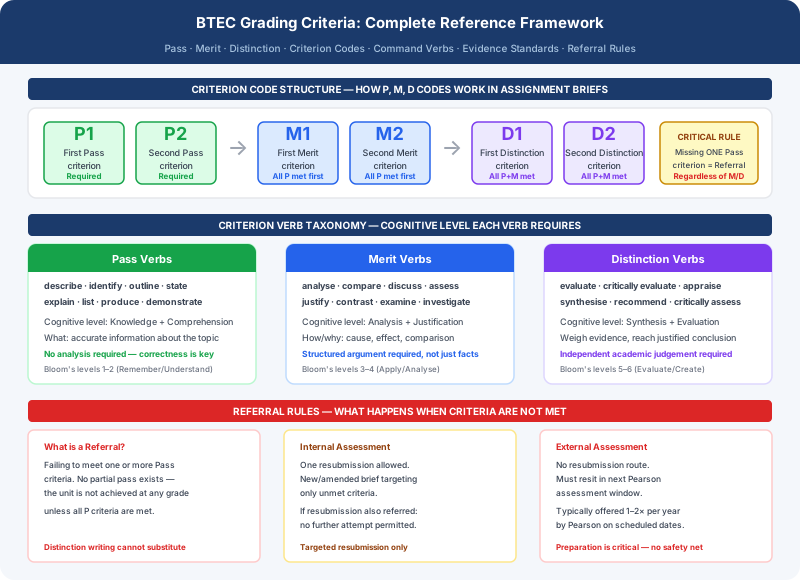
How BTEC Criterion Codes Work: P, M, and D Explained
Every BTEC Assignment Brief contains a criteria grid. Typically a table at the end of the brief — that lists all of the Pass, Merit, and Distinction criteria with their assigned codes. Each code has a letter (P, M, or D) indicating the grade band and a number indicating its position within that band in the unit: P1, P2, P3 are the first, second, and third Pass criteria; M1, M2 are the first and second Merit criteria; D1, D2 are the first and second Distinction criteria. Some units have only one Distinction criterion; others have three or more Pass criteria. The number of criteria and their distribution across grade bands varies by unit — always count the criteria in your specific brief before planning your response.
A student's grade on the unit is determined by the highest grade band for which all criteria are met. Meeting all Pass criteria = Pass grade. Meeting all Pass and all Merit criteria = Merit grade. Meeting all Pass, all Merit, and all Distinction criteria = Distinction grade. The hierarchical rule is absolute: Merit criteria cannot compensate for unmet Pass criteria, and Distinction criteria cannot compensate for unmet Merit criteria.
This has a critical practical implication that students frequently miss: a student who produces Distinction-quality writing for every criterion they address, but who omits one Pass criterion entirely — perhaps through not reading the brief carefully, or through misunderstanding which task was expected to address it — will receive a Referral. Not a Pass, not a Merit: a Referral, because the minimum threshold has not been met. The quality of the distinction-level work is irrelevant to the outcome on the criteria that are missing. Every criterion, at every grade band, must be individually and explicitly satisfied.
Some criteria in the brief are linked across tasks. A single piece of evidence might be expected to simultaneously satisfy P2, M2, and D2, because those three criteria relate to the same learning outcome at increasing levels of depth. Others are independent: P1 might assess theoretical knowledge while D1 assesses evaluation of an entirely different aspect of the unit. Mapping the relationships — linked or independent — before writing tells you where one extended piece of evidence at Distinction level can satisfy multiple criteria simultaneously, and where separate, distinct evidence is required for each.
Pass Criteria: What "Describe," "Explain," and "Identify" Require
Pass criteria use command verbs that operate at Bloom's taxonomy Levels 1 and 2 — recall and comprehension: describe, identify, outline, state, list, explain, apply, demonstrate, and produce. The common feature of all Pass criteria is that they require accurate, correct information presented at the appropriate level of detail — they do not require the student to analyse, compare, or evaluate. The cognitive task is the "what": what something is, what it does, what it consists of.
Describe means provide a detailed account of the characteristics, features, or components of the topic. A description answers "what" — what it is, what it does, what it consists of. For a BTEC Business unit, "describe types of business ownership" requires listing and providing characteristics of each type (sole trader, partnership, limited company, PLC, franchise, cooperative) — not comparing their relative advantages or recommending one over another.
Explain sits at a slightly higher level than describe — it requires the student to make the "how" or "why" clear, not merely list what exists. Explaining how something works, why a relationship exists, or what the mechanism of a process is. "Explain the impact of poor communication on care outcomes" requires the student to demonstrate the causal pathway between poor communication and a specific outcome — not merely state that poor communication exists in care settings.
Identify requires the student to recognise and name specific features, instances, or examples. It is a knowledge-level task — spotting and labelling — rather than analysing significance. A common student error with "identify" criteria is over-explaining in a way that consumes word count without adding Pass criterion evidence: identify means name and briefly characterise, not analyse in depth.
Meeting all Pass criteria is the non-negotiable foundation. A student whose priority is Distinction must still ensure every Pass criterion is individually and explicitly satisfied — a single missed Pass criterion produces a Referral regardless of the quality of higher-level content.
Merit Criteria: What "Analyse," "Compare," and "Discuss" Require
Merit criteria use command verbs that operate at Bloom's taxonomy Levels 3 and 4 — application and analysis: analyse, compare, discuss, justify, assess, examine, investigate, contrast. All Merit criteria require that all Pass criteria have already been met — Merit cannot be awarded on a unit where any Pass criterion remains unsatisfied. The cognitive task is "how" and "why": how something works at causal level, why relationships exist, how things compare in significance.
Analyse is the most frequently occurring Merit verb and the most frequently misapplied. Analysis requires breaking down a topic into its component parts and explaining the relationships between those parts — it answers "how" and "why" at a causal level. Analysis of a business's marketing strategy requires examining how each element of the marketing mix contributes to or detracts from the strategy's overall effectiveness, and explaining the mechanisms through which those effects occur. Describing the marketing mix at length is not analysis; applying it to explain strategic outcomes is.
Compare requires the student to identify similarities and differences between two or more things — theories, approaches, organisations, policies — and to explain the significance of those similarities and differences. A comparison that only lists differences (or only lists similarities) does not fully meet the criterion. A comparison that lists differences without explaining why those differences matter in the context of the assessment does not reach Merit standard.
Discuss requires exploration of multiple perspectives on an issue, consideration of arguments for and against, and engagement with the complexity of the topic. A discussion that presents only one viewpoint is not a discussion in the BTEC sense — it is a description with an opinion. Discussion involves structured consideration of competing positions using evidence. Critically, however, discussion does not require reaching a justified conclusion — that is Distinction territory. Merit-level discussion can acknowledge that the evidence is mixed without making a definitive evaluative judgement.
Distinction Criteria: What "Evaluate," "Critically Evaluate," and "Synthesise" Require
Distinction criteria use command verbs that operate at Bloom's taxonomy Levels 5 and 6 — synthesis and evaluation: evaluate, critically evaluate, appraise, synthesise, recommend, justify (in the sense of evidence-based justification for a reasoned position). All Pass and all Merit criteria must be met before Distinction can be awarded. The cognitive task is "to what extent" and "with what justification": weighing evidence to reach a supported conclusion, not explaining how things work.
Evaluate requires the student to make a judgement about the value, effectiveness, or significance of something — supported by evidence. An evaluation answers "to what extent" and "how effectively" questions. It requires weighing strengths against limitations, considering evidence on both sides, and reaching a supported conclusion. A response that lists advantages and disadvantages without making a judgement does not evaluate — it describes a comparison. The judgement: "the evidence suggests that X is more effective than Y in this context because...", is the evaluative element that earns Distinction.
Critically evaluate is a higher standard than evaluate, found more commonly at HNC and HND level. Critical evaluation requires the student to interrogate the assumptions underlying the analysis, question the reliability and validity of the evidence being used, identify the limitations of the theoretical frameworks applied, and acknowledge where the conclusion might not hold under different conditions. It is not simply negative evaluation — "critical" in the academic sense means rigorous, evidence-based interrogation, not criticism.
Synthesise requires the student to bring together information from multiple sources, frameworks, or perspectives to form an integrated account that goes beyond what any single source provides. Synthesis is not a summary of sources — it is the construction of a new analytical position that draws on multiple sources in a thematically organised way. In practice, synthesis at Distinction level means organising the response by analytical themes rather than source-by-source, using multiple sources within each theme to construct a supported argument.
How Criterion-Referenced Grading Differs from Mark-Based Assessment
BTEC grading is fundamentally different from A-level, GCSE, and degree grading in a way that many students — particularly those who have recently transitioned from A-level study — fail to internalise until they receive their first unexpected grade outcome. Understanding the difference is not just academic: it changes the strategy for every BTEC assignment submission.
In A-level and GCSE, marks accumulate across a paper and a percentage score determines the grade. Excellent answers compensate for weak answers elsewhere on the paper. A student who writes three outstanding essays and two mediocre ones gets a grade that reflects the aggregate performance. In BTEC, this logic does not apply. Each criterion is independently satisfied or not satisfied, and there is no mechanism by which strong performance on one criterion offsets weak performance on another. A submission with five excellent sections and one missing criterion on a Pass standard receives a Referral.
At degree level, assignment marking typically involves holistic judgement against marking criteria that allow for partial fulfilment — a submission can demonstrate some Merit-level engagement and some Pass-level engagement and receive a grade in the Merit range. In BTEC, the grade bands are not a spectrum. A submission that meets all Pass criteria and some, but not all, Merit criteria receives a Pass grade, not a Merit/Pass or a Merit-. Merit requires that every Merit criterion is satisfied — not that most are.
The practical strategy that follows from this is criterion coverage first, depth second. Before investing additional effort in deepening the analysis on criteria that are already met at Distinction level, confirm that every criterion at every level — including all Pass criteria — has been explicitly addressed. Then, and only then, does additional depth add to the grade.
BTEC Qualification-Level Grade Profiles: How Unit Grades Combine
Individual unit grades — Pass, Merit, and Distinction. Aggregate to produce the overall qualification grade profile. For BTEC National Level 3, qualification grades are expressed as combinations of unit grades: D*D*D*, DDD, DDM, DMM, MMM, MMP, MPP, PPP, and so on. Understanding how this aggregation works is important for students who are targeting specific UCAS points totals or university entry requirements, because the strategic implication is that not all unit grades are equally important to the target.
Distinction* (D*). The D* grade is available at BTEC National Level 3 only — it is not an available grade at HNC (Level 4) or HND (Level 5). D* is awarded at the qualification level, based on the combination of unit grades across the full qualification — it is not awarded on individual units. The specific unit grade combination required to achieve a D* overall qualification grade is set out in the Pearson qualification specification for each BTEC National programme. Students aiming for D* need to identify the required unit grade distribution from their specific qualification specification, not from a generic BTEC-to-UCAS equivalence table.
UCAS tariff values. At BTEC National Level 3, UCAS tariff points per unit are: D* = 56 points, D = 56 points, M = 48 points, P = 32 points. For the BTEC National Extended Diploma (three A-level equivalent), a D*D*D* qualification profile produces 168 UCAS points — equivalent to three A* grades at A-level. A DDM profile produces 160 points; a DMM profile produces 152 points. UCAS tariff points for the Extended Certificate (one A-level equivalent) and Diploma (two A-level equivalent) are calculated proportionally to the number of contributing units.
University entry requirements. Some degree programmes specify a minimum unit grade distribution rather than just an overall UCAS points total — for example, "minimum DD in the BTEC National Extended Certificate" or "minimum Distinction in a relevant unit." Always check the specific degree programme entry requirements rather than relying on a generic BTEC-to-A-level equivalence: admissions criteria vary significantly between institutions and subjects.
What is the single most important rule in BTEC grading criteria? Missing one Pass criterion produces a Referral — regardless of how much Distinction-quality work is in the same submission. Criterion coverage is the absolute priority. Before submitting any BTEC assignment, check every criterion in the brief — not just the highest-level criteria — against the submitted evidence. If you cannot point to a specific sentence or paragraph in the submission that explicitly satisfies a criterion, it has not been met.
BTEC Grading vs Degree Classification: Are They Comparable?
BTEC National, HNC, and HND grade profiles are not directly comparable to degree classifications (First, Upper Second, Lower Second, Third), but approximate comparisons are made in the context of degree progression. A Distinction at BTEC HND Level 5 demonstrates Level 5 academic achievement and is typically accepted by universities as sufficient for top-up degree entry — completion of the final year of a full Honours degree. Some universities articulate HND Distinction as broadly equivalent to a 2:1 standard at Level 5, though this varies by institution and programme.
For higher education progression, the key document is the university's entry requirements for the specific degree programme, not a generic BTEC grade equivalence table. Admissions criteria vary significantly between institutions and subjects — some specify a minimum Distinction profile across all HND units; others specify only a pass in the HND; a few specify particular unit grades relevant to the degree subject.
Related guidance: BTEC HND assignment help, How to achieve Distinction in BTEC assignments, and BTEC assignment resubmission guide.
Can Distinction-quality writing compensate for a missed Pass criterion in BTEC?
No. In BTEC, criterion-referenced grading means each criterion is independently assessed. If one Pass criterion is not met, the unit receives a Referral regardless of the quality of the rest of the submission. There is no compensatory marking or aggregate scoring — every criterion must be individually and explicitly satisfied. This is the most important rule in the BTEC grading system and the most common cause of students receiving a lower grade than their writing quality would suggest they deserve.
What is the difference between Pass and Merit verbs in BTEC assignments?
Pass verbs (describe, identify, explain, outline, produce) operate at Bloom's Level 1–2 — recall and comprehension — and require accurate knowledge and correct application: the "what" of a topic. Merit verbs (analyse, compare, discuss, justify, assess) operate at Bloom's Level 3–4 — application and analysis — and require structured analytical reasoning: the "how" and "why." The cognitive step from Pass to Merit is the step from knowing what something is to explaining how it works, why it has a particular effect, or how it compares to alternatives. A response written using Pass-verb logic will not achieve Merit, even if the content is accurate and extensive.
How many criteria does a typical BTEC unit have?
The number of criteria varies by unit, but most BTEC unit assignments contain between 6 and 12 criteria in total — typically 3–5 Pass criteria, 2–4 Merit criteria, and 1–3 Distinction criteria. Some smaller units have fewer; some larger or more complex units have more. The exact number is always visible in the criteria grid of the Assignment Brief. There is no standard number of criteria across all BTEC units — always count the criteria in your specific brief before planning your response.
What does "Distinction*" mean in BTEC National grading?
Distinction* (D*) is a grade available at BTEC National Level 3 only — not at HNC or HND. It is awarded at the qualification level based on the combination of unit grades across the full programme, not on individual units. The specific unit grade combination required to achieve a D* qualification profile is set out in the Pearson qualification specification for each BTEC National programme. In UCAS tariff terms, D* and D carry the same points value per unit (56 points each), but D* signals the highest overall achievement profile at National level.
Need expert help with your ATHE assignment?
Get Help NowCommon Questions
Is this service specific to BTEC qualifications?
Yes. We specialise exclusively in Pearson BTEC qualifications. Our writers are selected for their specific knowledge of BTEC units, marking criteria, and grade descriptors — not generic academic writing.
Will my assignment be plagiarism free?
Every assignment is written from scratch and run through Turnitin before delivery. You receive a copy of the originality report alongside your completed work.
How quickly can you complete my assignment?
Standard turnaround is 5–7 days. For urgent orders we offer 24-hour and 48-hour expedited delivery at an additional cost. Contact us to confirm availability for your deadline.
What if I'm not happy with the work?
We offer unlimited free revisions within 14 days of delivery. If we cannot meet your requirements after multiple revisions, we offer a full refund — no questions asked.