The BTEC Assignment Brief is the single most important document in BTEC assessment — it defines every criterion that will determine the grade, specifies what evidence is required, and maps each task to specific Pass, Merit, and Distinction criteria. Yet the majority of BTEC Referrals are caused not by insufficient subject knowledge but by insufficient engagement with the Assignment Brief before writing begins. Students who treat the brief as a set of instructions to follow rather than a criterion map to plan against consistently underperform against their knowledge level. This guide explains every section of a BTEC Assignment Brief in detail, how to apply scenario information to Merit and Distinction evidence, and the five-step reading strategy that ensures complete criterion coverage before a word of the submission is written.
The Structure of a BTEC Assignment Brief: What Each Section Contains
A BTEC Assignment Brief is a formal document produced by the centre tutor that sets out the unit being assessed, the tasks the student must complete, and the criteria against which the submission will be marked. Its structure is standardised across Pearson-accredited BTEC centres, though the formatting and presentation vary by centre. Every element of the brief serves a specific purpose in the assessment process — understanding what each section tells you changes how you approach the assignment before writing begins.
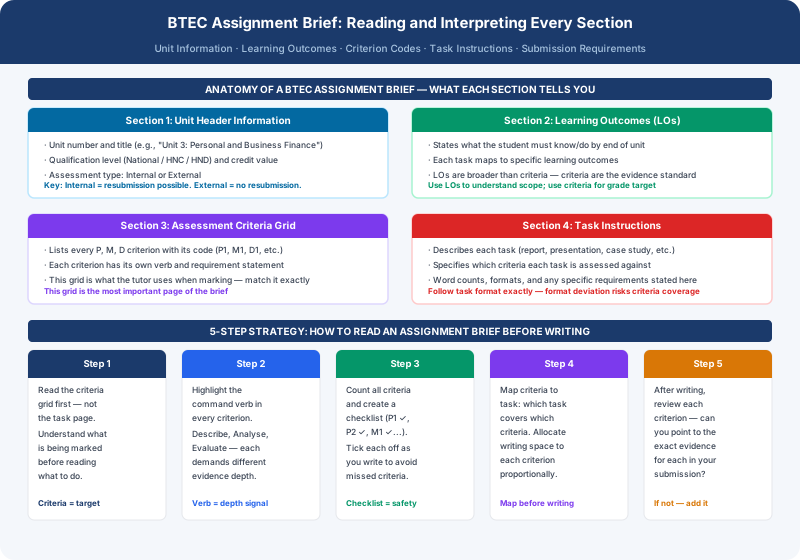
The unit header identifies the qualification (BTEC National, HNC, or HND), the unit number and title (e.g., "Unit 3: Personal and Business Finance"), the credit value of the unit, and whether the unit is internally or externally assessed. This last piece of information — internal or external — determines whether a resubmission route is available if the submission receives a Referral. Internal units: one resubmission permitted. External units: no resubmission — resit only in the next Pearson assessment window. Many students discover this distinction too late, after having treated an externally assessed unit with the same preparation approach as an internal unit.
The learning outcomes section states what the student will be able to know, understand, or do by the end of the unit. Learning outcomes are broader than individual criteria — they describe the unit's overall purpose and scope. Each task in the brief will be linked to one or more learning outcomes. Understanding the learning outcomes helps contextualise the criteria: they explain the intellectual territory the unit is covering. However, learning outcomes are not what is marked — the criteria grid is. Plan against the criteria grid, not the learning outcomes.
The assessment criteria grid is the most important section of the Assignment Brief. It lists every Pass criterion (Pn), every Merit criterion (Mn), and every Distinction criterion (Dn) with the exact wording of each criterion's evidence requirement. This is the grid the tutor uses when marking: every criterion is individually checked against the submitted evidence and either awarded or not awarded. The criteria grid is the marking instrument — everything the student writes should be planned to satisfy specific rows of this grid.
The task section describes what the student must produce for each task: a report, a presentation, a case study analysis, a practical portfolio, a database implementation. Tasks map to specific criteria — the brief should indicate which criteria each task is intended to cover. The task instructions also specify format requirements: word count guidelines, structure requirements, any mandatory sections, and any specific scenario or context information the student must respond to.
The submission requirements section specifies how and where to submit, the file format, the deadline, and the academic integrity declaration. Read this section before the deadline — not on the day of submission. A submission in an incorrect file format may not be assessable; a late submission may not be accepted.
Reading the Criteria Grid: The Most Important Part of the Brief
The criteria grid deserves careful reading before any other section of the brief. It tells you precisely what will determine your grade, and planning begins there. There are four things to extract from the criteria grid before writing a single word: the criterion verbs, the criterion content, the criterion relationships, and the criterion count.
The criterion verb is the command word in each criterion statement — describe, analyse, evaluate, discuss, compare. This verb defines the cognitive level of the evidence required. Identify the verb in every single criterion before planning the response, because the verb determines whether you need to describe (Pass), analyse (Merit), or evaluate (Distinction). A criterion that reads "Evaluate the impact of the external environment on a named organisation" requires evaluation — weighing evidence to reach a justified conclusion — not description or analysis. Writing analysis in response to an evaluation criterion will achieve Merit on that criterion at best.
The criterion content specifies the subject matter the criterion is assessing. "P1: Describe types of business ownership" requires description of business ownership types — it does not require anything about business objectives, stakeholders, or external environment. Those are other criteria. Criterion content scope matters because students frequently produce impressive, accurate content on the topic area while failing to address the specific content the criterion requires. Stay within the scope of each criterion.
Criterion relationships describe how Pass, Merit, and Distinction criteria connect to each other within the unit. Some units have linked criteria: P1, M1, and D1 all relate to the same topic area at increasing depth, and a single extended piece of evidence can satisfy all three if written at Distinction level throughout. Other units have independent criteria: P1 and D2 may be completely different learning outcomes, requiring separate evidence for each. Mapping the relationships before writing tells you where one piece of evidence can serve multiple criteria and where separate evidence is required.
The criterion count is simply how many criteria there are at each grade band. Count them. Know how many P, M, and D criteria exist before you write a single word. Before submitting, check your submission against each criterion by code. If you cannot locate evidence for P3, M2, or D1, those criteria have not been met — and you cannot afford to discover this after submission.
Task Instructions: What the Tasks Actually Tell You About Evidence Format
Task instructions in the Assignment Brief describe the activities the student must complete and the evidence formats required. They are detailed instructions that must be followed precisely — departing from the specified format risks not meeting the criteria that format was designed to evidence.
Common task formats in BTEC assignments include: written report (a formal document with an introduction, main body organised by criteria or theme, and conclusion — typically required at HNC and HND level); case study analysis (responding to a provided scenario by applying theory, legislation, or professional frameworks to the specific circumstances described — scenario engagement is a marking criterion, not just a framing device); presentation with supporting notes (a slide deck supported by written notes — the notes are where the criterion evidence sits; the slides are the delivery vehicle); portfolio (a collection of evidence documents showing completion of practical tasks — common in engineering, health and social care, and sport; completeness of all mandatory fields per entry is the primary quality marker); and research report (a structured academic document following a research methodology — most common at HND level).
Word counts: most BTEC Assignment Briefs include indicative word count guidance. This is guidance, not a strict limit — BTEC does not penalise exceeding or slightly falling short of word count targets. However, word counts exist to signal the expected depth and scope of the response. A 2,000-word assignment that receives 600 words of content is almost certainly not meeting all criteria. Conversely, a 2,000-word brief does not require 4,000 words to achieve Distinction — it requires the right type of evidence for each criterion, which may be achievable in 2,000 words or slightly more depending on criteria complexity.
Scenario information: where the task includes a scenario or stimulus material, the criteria are typically intended to be applied to that specific scenario. Generic responses that do not engage with the scenario details — applying business theory to a generic unnamed company rather than the company described in the brief — will often fail Merit and Distinction criteria even if the theory is accurately described and analysed. The scenario is the evidence context: treat it as a primary source, not as background.
Submission Requirements: Evidence Format, Plagiarism, and Academic Integrity
The submission requirements section of the Assignment Brief specifies how and where the submission should be made, the file format requirements, the deadline, and any academic integrity statements. Read this section carefully before the deadline — late submissions may not be accepted, and submissions in incorrect file formats may not be assessable.
Academic integrity statements in BTEC Assignment Briefs typically include a declaration that the work submitted is the student's own, that it has not been submitted for another assignment, and that all sources have been acknowledged. At HNC and HND level, the academic integrity requirements include proper Harvard referencing — submitting a Level 4 or Level 5 assignment without in-text citations and a reference list is not only poor academic practice but may constitute a form of academic misconduct where the work of others has been used without attribution.
Turnitin or similar plagiarism detection may be applied to BTEC submissions at some centres. A high similarity score does not automatically constitute plagiarism — similarity can result from correctly quoted and cited sources — but unlabelled copying from sources will be identified and reported. The safest approach is to paraphrase rather than quote wherever possible, and to cite all sources consistently using Harvard format.
At HNC and HND level, self-plagiarism — submitting work from a previous assignment (at this centre or another) as new original work — is also an academic integrity violation. If you wish to build on your own previous work from a different unit, acknowledge it as prior work and explain how the current submission extends or applies it differently. Never copy sections wholesale from your own prior submissions without acknowledgement.
Applying Scenario Information to Meet Merit and Distinction Criteria
Many BTEC Assignment Briefs include a scenario or stimulus document — a case study description, a company profile, an organisational context, statistical data, or a service user scenario. This material is not merely background framing; it is the specific context against which Merit and Distinction criteria are expected to be applied. The distinction between students who achieve Merit/Distinction and those who do not is often visible at exactly this point: scenario engagement.
Why scenario application matters for Merit and Distinction: examiner and tutor marks are allocated for scenario-specific engagement. A student who analyses the factors affecting business strategy using Porter's Five Forces in general terms — accurately, analytically, at what should be Merit level — but does not name the company described in the brief, does not use the revenue figures or market data provided, and does not discuss how the specific competitive environment in the scenario affects each force, will not fully satisfy a Merit criterion that reads "Analyse the factors affecting the marketing strategy of [named company]." The accuracy of the theory application is not in question; the failure is the absence of scenario specificity.
The anchor technique: before writing any Merit or Distinction response, identify the specific elements of the scenario relevant to that criterion — the company name, the workforce size, the specific problem described, the financial data provided, the named service user, the specific legislation mentioned in the scenario. Write those specific elements into every paragraph of the M/D response, not just the opening sentence. Criterion evidence that is anchored to scenario specifics throughout the response satisfies the criterion's scenario-application requirement in a way that theory-plus-scenario-mention at the start and end does not.
A common error is to write accurate, analytical Merit-level content and then add one scenario-connecting sentence at the end of each paragraph: "This applies to the case study organisation." This does not constitute scenario application — it is a gesture toward application that the assessor can see through. The scenario element — the specific company, the specific data, the specific context — needs to be integrated throughout the analysis, not appended as an afterthought. At Distinction level, the evaluative judgement must be made in the specific context of the scenario: not "this strategy is more effective in general" but "this strategy is more effective for this organisation because the scenario data shows..."
The Five-Step Assignment Brief Reading Strategy
The following five-step process, applied consistently before writing any BTEC assignment, eliminates the most common causes of missed criteria and unexpected grade outcomes. It takes approximately 30–45 minutes for an average assignment brief — and the return on that time investment, in terms of preventing referrals and maximising grade achievement, is significant.
Step 1: Read the criteria grid first, not the task page. The criteria grid tells you what is being marked. Reading it before the task instructions means you approach the task instructions knowing what you need to demonstrate, rather than approaching the criteria grid trying to reverse-engineer what evidence you have already decided to produce. The criteria are the target; the tasks are the vehicle for reaching the target.
Step 2: Highlight the verb in every criterion. Using a highlighter or annotation on screen, mark the command verb in every criterion (P1, P2, M1, etc.). Write down the cognitive level each verb implies: describe = knowledge; analyse = analysis; evaluate = evaluation. This gives you a rapid overview of the type of evidence required at each criterion level before you plan any content.
Step 3: Create a criterion checklist. On a separate document, list every criterion by code (P1, P2, P3, M1, M2, D1) with a brief note of what evidence it requires — both the verb level and the content scope. Leave space to record where in your submission you intend to address each criterion. This checklist becomes your criterion tracking document: you return to it during writing to confirm each criterion is being addressed, and you check against it before submission to confirm every criterion has been satisfied.
Step 4: Map criteria to tasks. Identify which task in the brief is expected to produce the evidence for which criteria. Some briefs map this explicitly; others require inference. Where the mapping is explicit, follow it. Where it must be inferred, use the learning outcomes and the task description to identify which criteria fall within each task's scope. Knowing the mapping before writing prevents the common error of producing evidence in the wrong task section — where it may not be visible to the assessor when they are checking a specific criterion.
Step 5: Pre-submission criterion check. After completing the submission but before submitting, return to the criterion checklist from Step 3 and verify each criterion. For each criterion, can you point to a specific sentence or paragraph in the submission that explicitly satisfies it? If not — if the criterion is implied rather than explicit, or if it is present but at the wrong cognitive level — address it before submitting. This pre-submission check is the most reliable single intervention for preventing unexpected Referrals.
Which section of the BTEC Assignment Brief matters most? The assessment criteria grid. Everything else — the task instructions, the learning outcomes, the scenario — serves the criteria grid. The criteria grid is what the tutor marks against, and it is what determines the grade. Read it first, plan against it, and check against it before submitting.
When the Assignment Brief Is Unclear: What Students Can Do
Assignment Briefs are written by individual tutors at individual centres, and their clarity and precision vary. If a criterion statement is ambiguous — if it is not clear what evidence is required to satisfy it — students have the right to ask their tutor for clarification before submitting. This is legitimate and encouraged: Pearson's assessment regulations require that briefs are clear and that students have a reasonable opportunity to understand what is expected.
When seeking clarification, ask specific questions about the criterion — not "what do I need to write for D1?" (too broad, risks the tutor effectively marking the assignment in advance) but "D1 asks me to evaluate the effectiveness of X — does this require comparison against Y, or is a standalone evaluation of X with identified limitations sufficient?" This kind of targeted question produces a useful answer and keeps the intellectual work with the student.
If the brief contains what appears to be an error — a criterion that references content not covered in the unit, a task that does not appear to map to any criterion, or a word count guidance that seems disproportionate to the criteria count — raise it with the tutor or centre coordinator before the deadline. Brief errors are rare but do occur, and they are the centre's responsibility to correct.
For grading and assessment guidance: BTEC grading criteria explained, BTEC resubmission guide, and How to achieve Distinction in BTEC assignments.
What is the most important section of a BTEC Assignment Brief?
The assessment criteria grid is the most important section. It lists every Pass, Merit, and Distinction criterion with its code and the exact evidence requirement for each. This is the document the tutor uses when marking — every criterion is individually checked against the submitted evidence. Read the criteria grid before the task instructions, plan your submission against the criteria grid, and check your submission against the criteria grid before submitting. Everything else in the brief serves the criteria grid.
What does "internal" and "external" mean on a BTEC Assignment Brief?
Internal assessment means the tutor at your centre wrote the brief, sets the tasks, and marks the submission against Pearson's criteria. Internal assessment units permit one resubmission if referred. External assessment means Pearson wrote the task (or examination), students complete it on a set date or within a controlled window, and Pearson marks the response. External assessment units have no resubmission — a fail means resitting in the next Pearson assessment window. Whether a unit is internal or external is stated in the unit header of the Assignment Brief.
Can I ask my tutor to explain what each BTEC criterion means before I start writing?
Yes. Asking for clarification about the meaning or evidence requirements of a criterion before submitting is legitimate and encouraged. Pearson's assessment regulations require that Assignment Briefs are clear and that students have a reasonable opportunity to understand what is expected. Ask specific, targeted questions about criteria you find ambiguous — not "what should I write for Distinction?" but "does this criterion require comparison between two approaches, or is a single evaluative analysis of one approach with identified limitations sufficient?" Specific questions get useful answers.
What is the difference between learning outcomes and assessment criteria in a BTEC Assignment Brief?
Learning outcomes describe what the student should know, understand, or be able to do by the end of the unit — they are broad educational objectives. Assessment criteria (the P, M, D criteria grid) specify the exact evidence required to demonstrate achievement at each grade level — they are the marking instrument. Learning outcomes provide context and scope; assessment criteria determine the grade. Use learning outcomes to understand the unit's purpose; use the assessment criteria grid for grade planning and pre-submission checking.
Need expert help with your ATHE assignment?
Get Help NowCommon Questions
Is this service specific to BTEC qualifications?
Yes. We specialise exclusively in Pearson BTEC qualifications. Our writers are selected for their specific knowledge of BTEC units, marking criteria, and grade descriptors — not generic academic writing.
Will my assignment be plagiarism free?
Every assignment is written from scratch and run through Turnitin before delivery. You receive a copy of the originality report alongside your completed work.
How quickly can you complete my assignment?
Standard turnaround is 5–7 days. For urgent orders we offer 24-hour and 48-hour expedited delivery at an additional cost. Contact us to confirm availability for your deadline.
What if I'm not happy with the work?
We offer unlimited free revisions within 14 days of delivery. If we cannot meet your requirements after multiple revisions, we offer a full refund — no questions asked.