
A BTEC Referral, the grade awarded when Pass criteria are not met, is not the end of the qualification. For internally assessed units, one resubmission opportunity exists, and a student who understands exactly what went wrong and how to fix it has a clear path to achieving the grade. The resubmission process has specific rules that many students misunderstand: what a targeted brief means, what can and cannot be changed, what the grade ceiling is after resubmission, what authentication requirements apply, and what to do when no resubmission route exists. This guide explains the complete BTEC resubmission process for both internal and external assessment.
What Is a BTEC Referral and What Causes It
A Referral is the BTEC term for a submission that has not met all of the Pass criteria for a unit. It is not a partial pass, a conditional pass, or a low pass, it means the minimum threshold for any grade has not been reached. A Referred unit has not been achieved. This is a non-negotiable binary outcome: Pass criteria are either met or they are not, and a single unmet Pass criterion, however many other criteria the submission satisfies, produces a Referral.
The most common causes of BTEC Referrals, in order of frequency, are: failing to address one or more Pass criteria (the criterion is simply absent from the submission, either because the student did not read the brief carefully or did not understand which task was expected to address it); addressing a criterion at the wrong cognitive level (describing when the criterion requires explanation, or explaining when analysis is required, more commonly a Merit issue but occasionally a Pass issue); and submitting incomplete evidence (producing a programming assignment without test evidence, a laboratory report without results, or a coaching session evaluation without the session plan).
A critical distinction: a Referral is different from an incomplete submission. Some centres accept interim submissions; others do not. Where an interim submission policy operates, a student who realises mid-submission that a criterion has not been addressed may have an opportunity to add the missing evidence before the deadline. Where no such policy operates, the first submission is the submission, and if it receives a Referral, the resubmission process applies. Understand your centre's submission policy before submitting, not after.
The BTEC Resubmission Process for Internally Assessed Units
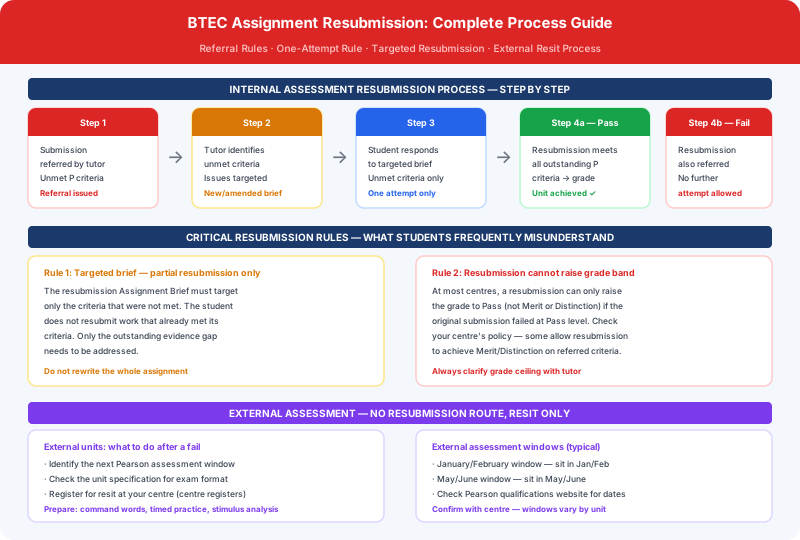
For internally assessed BTEC units, one resubmission opportunity is available following a Referral. This is guaranteed by Pearson's assessment regulations, the centre cannot deny a resubmission for an internally assessed unit to a student who has received a Referral on their first submission, subject to the student having submitted the original work by the centre's deadline. Late submissions may have different entitlements, check the centre's late submission policy before assuming the resubmission right applies.
After the Referral is confirmed, the tutor must issue a new or amended Assignment Brief specifically targeting the criteria that were not met. This is a key regulatory requirement: the resubmission brief must be targeted, not a repeat of the full original brief. A resubmission brief that instructs the student to redo the entire assignment, rather than addressing only the unmet criteria, does not comply with Pearson's regulations. If you receive a resubmission brief that appears to require a full redo, ask the tutor in writing to identify which specific criteria the resubmission is targeting, and keep a copy of the response.
The student does not resubmit all of the work, only the evidence addressing the criteria that were not met. Previously submitted evidence that already met its criteria remains part of the portfolio and does not need to be resubmitted. If P1 and P2 were met but P3 was not, the resubmission evidence only needs to address P3 (and any Merit or Distinction criteria that depend on P3 being met first, if the student wishes to achieve those grades).
The deadline for resubmission is set by the centre and must be within the same academic year, centres cannot carry resubmissions over to the following year. Confirm the resubmission deadline in writing when you receive the targeted brief. Missing the resubmission deadline has the same consequence as a second Referral: the unit is not achieved and no further attempt is available on that assignment.
Targeted Resubmission Brief: How to Use It Effectively
The targeted resubmission brief identifies the specific criteria that were not met in the original submission. Your entire preparation and writing effort for the resubmission should focus exclusively on those criteria, other criteria that were already met should not be revisited, as doing so risks inadvertently changing the quality of already-awarded evidence without improving the overall grade outcome.
Before writing the resubmission response, obtain the detailed feedback from the first submission, not just the criteria codes that were not awarded, but the tutor's comments on why those criteria were not met. This feedback is the most important input to a successful resubmission. Common patterns: the criterion was not addressed at all (write the missing content); the criterion was addressed at the wrong cognitive level (rewrite at the correct level, identify the verb and write to it); the criterion was partially addressed but evidence was incomplete (complete the missing element); the criterion was addressed in the wrong task section (place the evidence in the correct location).
Map the resubmission brief criteria to the feedback comments, and write a specific plan for how each unmet criterion will be addressed in the resubmission. Do not approach the resubmission by writing generally about the unit topic and hoping the new content satisfies the criteria, write directly to each criterion, using the verb in the criterion statement as the guide to the type of evidence required. Annotating the resubmission draft against the criteria codes before submission is the most reliable quality-check technique.
A practical note on word count: the resubmission is targeting specific criteria, not repeating the full assignment. The resubmission may be considerably shorter than the original submission. This is appropriate, focus on the quality and direct relevance of the new evidence, not on the length of the resubmission document.
Grade Ceiling After Resubmission: What Can and Cannot Be Achieved
Whether a resubmission can achieve Merit or Distinction as well as Pass depends on the centre's policy, the tutor's marking decision, and the original submission outcome. Pearson's regulations allow, but do not require, centres to award Merit and Distinction on resubmissions where the resubmission evidence meets those criteria as well as the Pass criteria that were not originally met.
In practice, most centres apply a Pass ceiling to resubmissions: a student who receives a Referral and resubmits successfully can achieve a Pass on the unit, but Merit and Distinction grades are not available through resubmission. The rationale is that resubmission is designed to allow students to demonstrate that they meet the minimum standard, not to upgrade the grade profile. Some centres, particularly at HNC and HND level, allow the full grade range on resubmission. Always clarify the grade ceiling policy in writing with your tutor, specifically, ask: "Is the maximum grade available on this resubmission a Pass, or can Merit and Distinction criteria also be awarded?", before submitting the resubmission, not after.
If the unit is one where Merit and Distinction cannot be achieved through resubmission and the original submission was a Referral, the student's strategic decision is: is a Pass on this unit sufficient for the overall qualification grade target? If a Distinction profile across the qualification is required for a specific university entry requirement, and this unit has been capped at Pass after resubmission, understand what qualification grade profile that produces and whether it still meets the progression requirements.
External Assessment Failures: The Resit Route and How to Prepare
For externally assessed BTEC units, there is no resubmission process. A Referral or fail on an external assessment unit means the student must resit the examination or Pearson-set task in the next available Pearson assessment window. The regulations are clear and non-negotiable: external assessment units are Pearson-marked, and resubmission as a concept does not apply, only resit in a future window.
Identifying the next assessment window: Pearson runs external assessment windows typically twice per year, a January/February window and a May/June window for most subjects. The exact dates and the process for registering are managed by the centre. Contact your programme coordinator or examinations officer to register for the next available resit; registration deadlines are typically several weeks before the examination date.
Preparing for an external assessment resit differently from the first attempt: the majority of students who fail an external BTEC assessment do so not because of insufficient subject knowledge but because of insufficient preparation for the examination format. The critical preparation activities are: reading the command words in past papers and practising matching the response type to the command word; practising timed responses under examination conditions (timed writing without notes); analysing the stimulus material before answering questions, as BTEC external assessments routinely require application to stimulus material rather than generic subject knowledge; and reviewing the Pearson mark scheme for any available past papers to understand what a Pass, Merit, and Distinction response looks like in the examiners' view.
Students who treat the external assessment resit as an opportunity to revise subject content alone, without addressing their examination technique, typically produce the same quality of response as the first attempt. The subject knowledge was adequate; the examination response skills were not. Targeted examination technique development is the priority for resit preparation.
Authentication and Academic Integrity on BTEC Resubmissions
All resubmitted work requires an authentication declaration: the work submitted is the student's own, complies with the centre's academic integrity policy, and has not been submitted for another assignment at this or any other centre. This declaration applies equally to the original submission and to the resubmission. At HNC and HND level, the authentication requirements also include Harvard referencing, submitting Level 4 or Level 5 resubmission evidence without proper in-text citations is both poor academic practice and an integrity concern where sources have been used without attribution.
Understanding what legitimate support looks like: using assignment guidance services to develop understanding of the criteria, what cognitive level each criterion verb requires, what evidence structure meets each criterion, what Distinction-level responses look like compared to Merit-level responses, is legitimate preparation. It develops the student's ability to produce their own well-structured, criterion-focused resubmission evidence. What is not legitimate is submitting work written by another person as the student's own; this constitutes academic malpractice under Pearson's assessment regulations and carries the same consequences as plagiarism in the original submission.
Pearson's internal verification process samples resubmissions. Internal verifiers check that the resubmission brief was appropriately targeted (not a full-redo brief), that the new evidence addresses only the unmet criteria, and that the authentication declaration is in order. Where malpractice is identified on a resubmission, the consequences are potentially more serious than on the original submission, the student has already received feedback indicating exactly what needed to improve, making the case for deliberate circumvention of the assessment process more straightforward to establish.
The practical standard: a resubmission that the student can explain in a face-to-face conversation with the tutor, explaining what criterion was not met, why, and what the new evidence does to address it, is a resubmission that reflects genuine learning. A resubmission the student cannot explain is not.
What is the most important thing to do before starting a BTEC resubmission? Read the tutor's feedback from the original submission in detail, identify the specific reason each criterion was not awarded, not just which criteria were not awarded, and ask for clarification in writing if the feedback is unclear. Resubmissions that do not address the specific reason for the original Referral, and instead add more content of the same type that was already insufficient, risk a second Referral and the end of any further attempts on the unit.
BTEC Resubmission and Academic Integrity
BTEC assessment regulations require that all resubmitted work is the student's own and complies with the centre's academic integrity and plagiarism policy. The resubmission process is not an opportunity to have the assignment rewritten externally and submitted as the student's own work, this constitutes malpractice and carries the same consequences as plagiarism in the original submission: potential removal of the grade for the entire unit, and in serious cases, removal from the qualification programme.
Using assignment guidance services for the purpose of understanding the assignment and developing the response is different from submitting work that is not your own. Understanding the criteria, understanding what evidence is required, and understanding how to write at the appropriate cognitive level for each criterion is legitimate preparation. The submitted response must be the student's own work, developed from that understanding.
For assessment guidance across the qualification: BTEC grading criteria explained, How to read your assignment brief, and How to achieve Distinction in BTEC assignments.
How many times can I resubmit a BTEC assignment?
For internally assessed BTEC units, one resubmission is permitted following a Referral. If the resubmission also receives a Referral, no further attempt is available on that assignment. The unit has not been achieved, and the student may need to negotiate alternative arrangements with the centre, retake the unit, or in some cases repeat a year of study. There is no automatic right to a third attempt. For externally assessed units, there is no resubmission route, the student must resit in the next Pearson assessment window.
Can I improve my grade from Pass to Merit or Distinction through resubmission?
Resubmission is available only following a Referral, failure to meet Pass criteria. A student who has achieved a Pass grade cannot resubmit to improve to Merit or Distinction; the submission has been completed and graded. If you achieve a Pass but want Merit or Distinction, this is not available through the resubmission process, the Pass grade stands. Resubmission is specifically a mechanism for addressing Referrals, not for grade improvement above the Pass threshold.
What happens if I miss the resubmission deadline?
Missing the resubmission deadline typically means the resubmission opportunity is forfeited, the unit remains unachieved with no further attempt permitted on that assignment. The centre may have specific procedures for exceptional circumstances (illness, bereavement), but these are not automatic entitlements and must be supported by appropriate evidence. Contact your programme coordinator immediately if you are at risk of missing a resubmission deadline, do not wait until after the deadline to explain the circumstances.
Do I have to resubmit the entire assignment or just the parts that were referred?
You only need to address the criteria that were not met. The resubmission is targeted: Pearson's regulations require the tutor to issue a brief targeting only the unmet criteria, not the full original brief. Evidence that already met its criteria does not need to be resubmitted. If your tutor has issued a resubmission brief that appears to require a full redo of the assignment, ask them in writing to identify which specific criteria the resubmission is targeting. The resubmission is about filling the specific evidence gap, not repeating the whole assignment.
Need expert help with your ATHE assignment?
Get Help NowCommon Questions
Is this service specific to BTEC qualifications?
Yes. We specialise exclusively in Pearson BTEC qualifications. Our writers are selected for their specific knowledge of BTEC units, marking criteria, and grade descriptors — not generic academic writing.
Will my assignment be plagiarism free?
Every assignment is written from scratch and run through Turnitin before delivery. You receive a copy of the originality report alongside your completed work.
How quickly can you complete my assignment?
Standard turnaround is 5–7 days. For urgent orders we offer 24-hour and 48-hour expedited delivery at an additional cost. Contact us to confirm availability for your deadline.
What if I'm not happy with the work?
We offer unlimited free revisions within 14 days of delivery. If we cannot meet your requirements after multiple revisions, we offer a full refund — no questions asked.