Achieving Distinction in BTEC assignments requires a combination of complete criterion coverage and a specific quality of analytical and evaluative writing that is systematically different from what passes at Merit level. Students who consistently produce Merit grades are often technically competent and knowledgeable, the barrier is not subject knowledge, it is the ability to move from explaining how things work to evaluating their significance, weighing competing evidence, and reaching a justified conclusion. This guide explains exactly what Distinction-level BTEC writing looks like, what assessors are looking for in D-criterion responses, the structural strategies that produce consistent Distinction outcomes, and the pre-submission checklist that confirms Distinction evidence is actually present before submitting.
What Distinction-Level Evidence Actually Means in BTEC Assignments
Distinction criteria in BTEC assignments use verbs at Bloom's synthesis and evaluation levels: evaluate, critically evaluate, synthesise, appraise, recommend, and justify (in the sense of evidence-based justification for a reasoned position). These verbs describe a cognitive activity that is structurally different from description or analysis, they require the student to make a judgement, reach a position, and defend it with evidence.
The most precise way to understand what Distinction requires is to ask the question: "to what extent?" Pass answers "what?" Merit answers "how and why?" Distinction answers "to what extent, and with what justification?" A student who can look at a business strategy, a care approach, a physical training programme, or a government policy and say "this is more effective than the alternative because..." followed by specific evidential reasoning, and who can identify the conditions under which that conclusion might not hold, is operating at Distinction level.
Distinction is not about writing more. Students frequently mistake length for depth and produce extensive Merit-level analysis in the belief that more of the same will eventually constitute Distinction. It will not. The additional word count needs to operate at the evaluative level, weighing, judging, concluding, not extending the analytical content. A Distinction response that is shorter but contains a clearly reasoned, evidence-supported evaluative conclusion will achieve Distinction. A longer Merit response will achieve Merit, regardless of length.
Distinction also requires that every Pass and Merit criterion has been met first. This is the non-negotiable prerequisite. A brilliant evaluative conclusion cannot be awarded Distinction if a Pass criterion somewhere in the same assignment has been missed. Check the entire criteria grid against the submitted evidence before treating the evaluative content as the priority: Distinction criterion coverage must sit on a foundation of complete P and M criterion coverage.
The Five Components of a Distinction-Level BTEC Response
Consistently achieving Distinction across multiple BTEC assignments requires building five specific capabilities into every response. These components are not mutually exclusive, they work together, but understanding each individually makes it easier to diagnose where a Merit-level response falls short and what needs to change to reach Distinction.
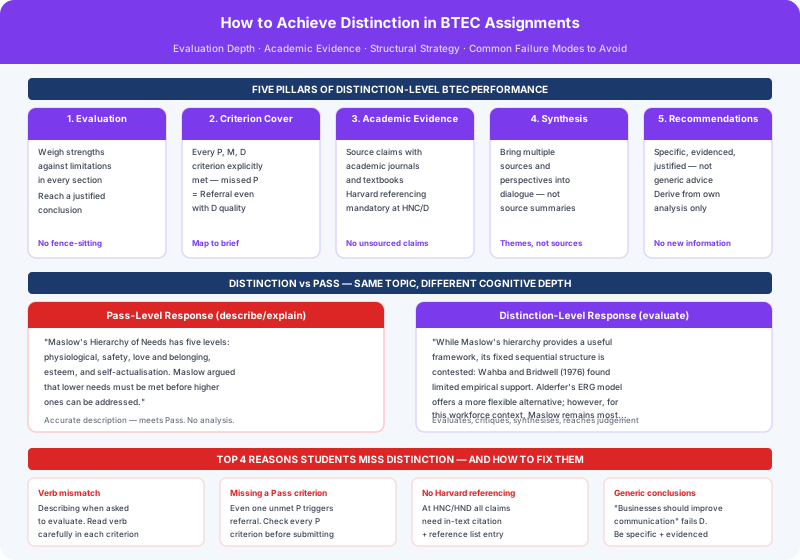
1. Evaluative depth at the conclusion. Every section that addresses a Distinction criterion must reach a conclusion, not a summary of what was said, but a reasoned judgement about what the evidence means. "Based on the analysis above, the evidence suggests that X is the more significant factor because it consistently appears across multiple theoretical frameworks and is supported by the empirical literature." The conclusion makes a claim and defends it. Without this, a thorough analytical section remains at Merit standard.
2. Engagement with competing perspectives. Distinction-level responses acknowledge that more than one position exists and engage with the strongest counter-arguments. This is not fence-sitting, it is demonstrating that the conclusion reached has considered the alternatives and has a reason for being preferred over them. A one-sided argument, however well-written, is less credible academically than a balanced argument that reaches a justified conclusion despite acknowledging contrary evidence.
3. Specific, evidenced recommendations. Many Distinction criteria require recommendations, for an organisation, a care approach, a design, a policy. Distinction-level recommendations are specific (not "businesses should improve communication" but "the organisation should implement structured monthly one-to-one review meetings between line managers and direct reports"), actionable, and derived from the evidence presented in the analysis. Recommendations that introduce new information not discussed in the preceding analysis do not meet Distinction criteria.
4. Academic sourcing at the appropriate level. At BTEC National Level 3, academic sources are helpful but not universally required. At HNC Level 4, Harvard-referenced academic sources are mandatory for Merit and Distinction criteria, all substantive claims must be supported by in-text citations from academic textbooks or peer-reviewed journals. At HND Level 5, peer-reviewed journal articles are expected alongside textbooks for Distinction criteria, textbook citations alone may be insufficient evidence of the level of engagement required at Level 5. Sourcing requirements escalate with qualification level; match the sourcing to the level.
5. Explicit criterion mapping. Before submitting, map the submitted evidence to each criterion in the brief by code. If you cannot point to a specific sentence or paragraph that satisfies P1, M1, and D1 individually, those criteria have not been met. Distinction students develop the habit of self-assessing their work against the criteria grid before submission, not after receiving feedback. This is the structural discipline that separates consistently high-achieving BTEC students from those who produce occasional Distinction grades alongside unexpected Referrals.
Distinction vs Merit: The Critical Difference in Writing Style
The writing style difference between Merit and Distinction is not about vocabulary, sentence length, or academic register, it is about the presence or absence of evaluative judgement. Two students can write at exactly the same technical level of prose quality, referencing quality, and subject knowledge depth, and one will achieve Distinction while the other achieves Merit, because one makes evaluative judgements and the other does not. The difference is visible at the sentence level.
Merit-level writing presents information and analysis: "Maslow's Hierarchy of Needs argues that physiological needs must be met before higher-order needs can be addressed. This theory has been applied in organisational contexts to explain employee motivation. Herzberg's Two-Factor Theory distinguishes between hygiene factors and motivators." This is accurate and analytical, it is Merit.
Distinction-level writing evaluates: "While Maslow's hierarchical model provides a practical framework for understanding basic need satisfaction in the workplace, its empirical foundations have been questioned (Wahba and Bridwell, 1976), and its rigid sequential structure fails to account for simultaneous need satisfaction observed in longitudinal studies. Herzberg's Two-Factor Theory is arguably more useful for organisational practice because it distinguishes between need types that respond differently to management interventions, a distinction Maslow's model does not make. However, both theories share the limitation that they were developed in mid-twentieth-century North American contexts and their cross-cultural applicability, particularly in collectivist cultures, is contested (Hofstede, 1980)." This is Distinction: it evaluates competing theories, identifies limitations, reaches a justified position, and acknowledges conditions under which the conclusion may not hold.
The practical exercise for moving from Merit to Distinction: after writing an analytical section, ask "so what?" and write the answer. The "so what?" forces an evaluative statement, an implication, a judgement, a recommendation that follows from the analysis. If the analysis does not generate a "so what?" answer, the analysis itself may not be providing sufficient evaluative content for the Distinction criteria.
Harvard Referencing and Academic Sourcing for BTEC Distinction
At HNC and HND level, Harvard referencing is not a presentation requirement separate from the intellectual content, it is evidence of academic engagement. A Distinction-level claim at Level 4 or above that is not supported by a correctly formatted in-text citation will typically not be awarded the Distinction criterion, because the criterion's requirement to engage with academic evidence has not been demonstrated. The source is the evidence; the citation is the proof that the source was engaged with.
The Harvard in-text citation format: (Author Surname, Year of Publication). Multiple authors at first reference: (Smith, Jones and Brown, 2019). On subsequent references: (Smith et al., 2019). Direct quotations require a page number: (Smith, 2019, p.45). The reference list entry for a book: Author Surname, Initial. (Year) Title in italics. Edition (if not first). Place of publication: Publisher.
Selecting appropriate academic sources for Distinction criteria: at Level 3, credible textbooks and quality websites (NHS, GOV.UK, BBC, professional bodies) are generally sufficient. At Level 4 HNC, core subject textbooks are the minimum; peer-reviewed journal articles are expected for Distinction criteria in analytical and evaluative sections. At Level 5 HND, peer-reviewed journals should predominate in Distinction-criterion sections, textbook citations are not evidence of Level 5 independent academic research. Journal databases available through most college library portals include JSTOR, ProQuest, EBSCO, and Google Scholar.
Common Harvard referencing errors that risk criteria: citing a website without an author (use the organisation as author); failing to include the access date for online sources; citing a textbook edition that differs from what is available; including sources in the reference list that do not appear as in-text citations (or vice versa). At HNC and HND level, tutors and internal verifiers check reference list accuracy, inconsistencies between in-text citations and the reference list are a frequently noted quality issue in Pearson's external moderation reports.
Subject-Specific Distinction Strategies: What Different BTEC Subjects Require
While the general principles of Distinction apply across all BTEC subjects, evaluation, synthesis, justified judgement, the specific form that evaluative evidence takes varies significantly by subject. Understanding what Distinction evidence looks like in your specific subject prevents the error of applying a generic approach that does not match the criteria's intent.
BTEC Business: Distinction requires evaluation of business strategy, market analysis, or financial data. At HND, this means using theoretical frameworks (Porter's Five Forces, Ansoff Matrix, PESTLE) as analytical lenses, then critically evaluating the framework's applicability to the specific business context being analysed, acknowledging where the framework does not map cleanly onto the evidence. Recommendations at Distinction should be commercially specific and financially justifiable where the unit includes financial analysis.
BTEC Health and Social Care: Distinction requires applying care theory and legislation to a service user scenario with evaluative professional judgement. The evaluative element in H&SC is typically a recommendation about the most appropriate care approach, justified by evidence and attentive to the tension between autonomy and protection, or between competing theories of care. Reflective practice at Distinction requires critical self-assessment, not just description of an event but evaluation of what should change and why the existing approach was insufficient.
BTEC Engineering: Distinction requires evaluating engineering analysis, identifying assumptions, quantifying uncertainty, comparing the calculated result against theoretical expectations, and recommending design modifications with engineering justification. In laboratory reports, evaluating experimental error sources, systematic vs random, magnitude, effect on conclusion, and proposing methodological improvements is the primary Distinction evidence requirement.
BTEC IT and Computing: Distinction requires evaluating technical solutions against alternatives, comparing algorithms, data structures, design patterns, or system architectures, and justifying the preferred approach with reference to the specific requirements of the task. At HNC and HND, engaging with technical standards (ISO, NCSC, IEEE) and academic computer science literature in the evaluation section demonstrates the Level 4/5 sourcing standard that Distinction criteria require.
BTEC Sport: Distinction requires evaluating sport science theory and evidence in the context of specific athletic scenarios. For anatomy and physiology, this means evaluating the relative contributions of physiological systems to a sport performance profile. For coaching and training, this means critically assessing the evidence base for specific training methods and reaching a justified recommendation about their appropriateness for the athlete described in the assessment scenario.
The Pre-Submission Distinction Checklist
The most reliable single intervention for consistently achieving Distinction is a structured pre-submission check, applied to every BTEC assignment before it is submitted. The checklist below addresses each of the five Distinction components and verifies criterion coverage at every grade level. Allow 20–30 minutes for this check on a full assignment; the time investment prevents the most common causes of unexpected Merit grades and Referrals.
Step 1. Verb check: For every Distinction criterion, identify the command verb and confirm that the submitted response operates at that cognitive level. "Evaluate" requires a reasoned judgement; "synthesise" requires thematic integration of multiple sources; "critically evaluate" requires interrogation of assumptions and evidence limitations. If the response analyses without concluding, the Distinction criterion has not been met.
Step 2. Evaluative conclusion present: Every section addressing a Distinction criterion must end with a reasoned, supported conclusion, not a summary of what was discussed, but a judgement about what the evidence means. If the final sentence of each D-criterion section describes content rather than evaluates it, add the evaluative conclusion before submitting.
Step 3. Recommendations derived from evidence: Any recommendation in the submission was discussed in the preceding analysis. If a recommendation introduces information not present in the earlier analysis, either the analysis needs extending or the recommendation needs to be grounded in what was actually analysed. Never introduce new information in a recommendation section.
Step 4. Citations present and correct (HNC/HND): Every substantive claim in a Distinction-criterion section has an in-text citation in Harvard format. The reference list at the end of the submission is complete and matches every in-text citation, no sources in the list that are not cited in the text, and no in-text citations that do not appear in the reference list.
Step 5. No Pass criteria missing: Check every Pass criterion by code against the submitted evidence. For each P criterion, can you point to a specific sentence or paragraph that explicitly satisfies it? If not, if the criterion is implied rather than explicit, or present but at the wrong cognitive level, address it before submitting. A single missing P criterion produces a Referral regardless of Distinction-level work elsewhere.
Step 6. Evidence in correct task section: Criterion expected to be evidenced in Task 2 is actually addressed within Task 2 content, not implied by content appearing in Task 1. Tutors typically check criteria per task, evidence in the wrong section may not be counted for a criterion it was intended to satisfy.
Step 7. Synthesis present where required: Where a criterion uses "synthesise," the response draws on multiple sources thematically, themes are the organising principle, not individual source summaries. If the structure is "Source A says... Source B says... Source C says...", it is not synthesis; reorganise by theme with multiple sources per theme.
Step 8. Criterion code annotation: As a final check, annotate the draft document with criterion codes in the margin next to the evidence for each criterion. If you cannot annotate a specific criterion code, the evidence for it is not clearly present and the criterion has not been met.
What is the fastest way to diagnose why a BTEC submission achieved Merit rather than Distinction? Find the Distinction criterion in the brief, identify its verb, and check whether the submitted response makes an evaluative judgement. If the response analyses, compares, and explains without reaching a reasoned conclusion, without answering "to what extent" and "with what justification", the Distinction criterion has not been met. The fix is adding the evaluative conclusion to the existing analytical content, not rewriting the section.
Distinction at National vs HNC vs HND: How the Standard Escalates
The cognitive standard for Distinction is the same at all three levels, evaluation, synthesis, justified judgement, but what constitutes sufficient evidence for that standard increases with the qualification level. At BTEC National Level 3, a well-reasoned evaluative paragraph that compares two theories or approaches and reaches a justified conclusion, drawing on course materials and quality general sources, typically meets the Distinction criterion. Academic sourcing is beneficial but not universally required.
At HNC Level 4, the same evaluative argument must be supported by Harvard-referenced academic sources. The theoretical frameworks applied should be the established theories in the academic literature of the subject, not generic descriptions. The depth of engagement with theory, acknowledging its limitations, comparing it against alternatives, must be demonstrably at Level 4 academic standard.
At HND Level 5, peer-reviewed journal literature is expected for Distinction-criterion responses. The synthesis should bring together multiple academic sources thematically to construct an argument that goes beyond any single source. Independent academic judgement, the student's own analytical position, not merely a summary of what the literature says, is the Level 5 standard that Distinction requires.
For subject-specific guidance: BTEC grading criteria explained, How to read and interpret your assignment brief, and BTEC HND assignment help.
What is the most common reason BTEC students miss Distinction?
The most common reason is criterion verb mismatch, students produce analytical writing (Merit level) in response to a Distinction criterion that requires evaluation. Analysis explains how and why; evaluation weighs evidence and reaches a justified judgement. The second most common reason is missing a Pass criterion, which triggers a Referral regardless of the quality of higher-level content. Before submitting, check every criterion against the submitted evidence, and ensure Distinction-criterion responses make an explicit, evidenced evaluative judgement.
Does writing more always improve a BTEC grade?
No. Extending a Merit-level response does not make it a Distinction-level response, it produces a longer Merit response. Distinction requires a qualitative change in the type of evidence: evaluative judgement, synthesis, and justified recommendations, not more analysis. Word count beyond what is needed to meet each criterion's evidence requirements does not add to the grade. A concise Distinction-level response will achieve Distinction; an extensive Merit-level response will achieve Merit, regardless of length.
Is Harvard referencing required to achieve Distinction at BTEC National level?
Harvard referencing is not a mandatory requirement at BTEC National Level 3 in the same way it is at HNC and HND level. However, using credible sources and acknowledging them strengthens the evaluative claims in Distinction criteria and is good academic practice. At HNC Level 4 and HND Level 5, Harvard referencing is mandatory. Distinction criteria at these levels will not be fully satisfied without correctly formatted in-text citations and a reference list.
What should a Distinction recommendation look like in a BTEC assignment?
A Distinction recommendation must be specific, actionable, and directly derived from the evidence in the assignment. "The organisation should improve its processes" does not meet Distinction standard, it is generic. "Based on the finding that staff turnover in the customer service department is 34% above the sector average and that exit interviews identify workload distribution as the primary driver, the organisation should implement a revised shift allocation system in this department, piloting a four-day week model over one quarter and measuring retention against baseline" meets Distinction standard because it is specific, evidenced, and derived from analysis. Never introduce new information in recommendations that was not discussed in the preceding analysis.
Need expert help with your ATHE assignment?
Get Help NowCommon Questions
Is this service specific to BTEC qualifications?
Yes. We specialise exclusively in Pearson BTEC qualifications. Our writers are selected for their specific knowledge of BTEC units, marking criteria, and grade descriptors — not generic academic writing.
Will my assignment be plagiarism free?
Every assignment is written from scratch and run through Turnitin before delivery. You receive a copy of the originality report alongside your completed work.
How quickly can you complete my assignment?
Standard turnaround is 5–7 days. For urgent orders we offer 24-hour and 48-hour expedited delivery at an additional cost. Contact us to confirm availability for your deadline.
What if I'm not happy with the work?
We offer unlimited free revisions within 14 days of delivery. If we cannot meet your requirements after multiple revisions, we offer a full refund — no questions asked.