BTEC Health and Social Care assignment help covers every unit at Level 3 National, Level 4 HNC, and Level 5 HND, from Human Lifespan Development and Safeguarding at National level through to anatomy, physiology, and reflective practice at Higher National level. Each unit's Pass, Merit, and Distinction criteria require a fundamentally different type of evidence, and the most common cause of referrals in BTEC H&SC is applying care theory to service user scenarios without the analytical or evaluative depth the criteria demand. This service provides criterion-specific guidance that maps evidence directly to each P, M, and D requirement in the Assignment Brief.
BTEC Health and Social Care Unit Structure: National and HND Overview
BTEC National Children, Young People and Families (formerly titled Health and Social Care at many centres) is delivered as an Extended Certificate, Diploma, or Extended Diploma at Level 3. The core units run across the full qualification range and include Human Lifespan Development, Working in Health and Social Care, Meeting Individual Care and Support Needs, and Safeguarding and Protection of Vulnerable Individuals. Optional units vary by college and may include anatomy and physiology, mental health, working with children, and research in health and social care.
Assessment at National level is entirely internal, all units are tutor-set, centre-marked, internally verified, and Pearson-moderated. There are no external examinations at BTEC National Health and Social Care, unlike subjects such as Business. This means every unit carries a resubmission option if the initial submission receives a Referral, and preparation should focus on criterion evidence quality rather than exam technique.
At HNC Level 4, Health and Social Care or Healthcare Practice programmes include units such as Professional Practice, Anatomy and Physiology for Health, Research Methods, and Interprofessional Working. Harvard referencing is mandatory at HNC level. At HND Level 5, units shift toward strategic and management analysis: leadership in health and social care settings, managing quality and service improvement, and policy analysis. The Managing a Successful Business Project equivalent at HND level in health and social care is typically a practice-based research project of 5,000–6,000 words.
BTEC Health and Social Care Unit 1: Human Lifespan Development Assignment Help
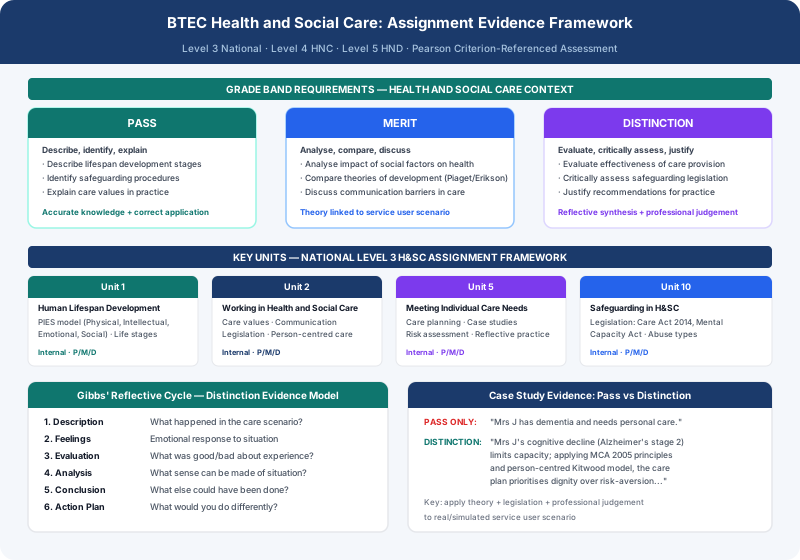
Human Lifespan Development is one of the core units at BTEC National and examines physical, intellectual, emotional, and social (PIES) development across six life stages: infancy (0–2), early childhood (3–8), adolescence (9–18), early adulthood (19–45), middle adulthood (46–65), and later adulthood (65+). Each stage must be addressed across all four PIES domains for the Pass criteria to be met.
The most common Pass criteria failure in this unit is incomplete PIES coverage, students address physical and emotional development in detail but provide insufficient evidence for intellectual and social development within the same life stage. Every PIES domain must be explicitly covered for each life stage referenced by a Pass criterion, not merely mentioned.
Merit criteria for this unit require analysis of factors affecting development. Expected factors include genetic inheritance, lifestyle choices, poverty and socioeconomic status, illness and disability, educational experience, and the influence of family and community. The Merit standard requires the student to explain the mechanism by which the factor affects development, not simply list the factor. For example, stating "poverty affects development" is Pass-level recognition; explaining how poverty reduces access to nutritionally adequate food, which in turn impairs physical growth and cognitive development in early childhood by affecting synaptic development, is Merit-level analysis.
Distinction criteria typically require evaluation of the relative impact of different factors on development, which has the greatest effect, why, and with what evidence. Students should reference theoretical frameworks such as Bronfenbrenner's ecological systems theory, which considers the interrelationship between microsystem, mesosystem, exosystem, and macrosystem influences on development, to demonstrate the synthesised understanding Distinction requires.
BTEC Health and Social Care Safeguarding Assignment Help
Safeguarding units at BTEC National require students to demonstrate knowledge of abuse types, relevant legislation, and the procedures for reporting and responding to safeguarding concerns. The primary legislation governing safeguarding practice in England and Wales includes the Children Act 1989 and 2004, the Care Act 2014, the Mental Capacity Act 2005, the Safeguarding Vulnerable Groups Act 2006, and the Children and Social Work Act 2017.
Pass criteria in safeguarding units require students to describe the different types of abuse, physical, emotional, sexual, neglect, financial, institutional, and domestic violence, and to outline the legislation and procedures that apply in each case. A common Pass failure is describing abuse types without connecting each to the specific legislative framework that governs the duty to act.
Merit criteria require analysis of how legislation and policy frameworks protect vulnerable individuals. This means explaining the mechanisms by which legislation creates obligations for practitioners, for example, the Care Act 2014 s.42 duty on local authorities to make enquiries when an adult may be at risk of abuse or neglect, and how this translates into the Safeguarding Adult Review process. Procedural knowledge alone does not constitute Merit analysis; the analytical standard requires examination of how and why the procedure functions as a protective mechanism.
Distinction criteria typically require evaluation of safeguarding practice, identifying where current legislation or procedures have limitations, where multi-agency working has failed (referencing high-profile cases such as Victoria Climbié, Baby P, or Daniel Pelka), and what systemic changes have been recommended and why. A critical evaluation that identifies the gap between legislative intent and practice outcomes, supported by inquiry reports or academic literature, meets the Distinction standard.
How to Write a BTEC Health and Social Care Case Study for Distinction
Case studies are the primary vehicle for demonstrating applied knowledge in BTEC Health and Social Care, particularly at National level. The Assignment Brief typically provides a service user scenario, a description of a fictional individual with a specified health condition, care need, or life circumstance, and the student must apply theory, legislation, and care values to that scenario in a way that satisfies each criterion.
The Pass standard requires accurate identification of the service user's needs and a correct description of relevant care theories, legislation, or procedures. The failure mode at Pass is failing to link the theory or legislation to the specific details of the case, applying generic descriptions of dementia care to a service user scenario involving a child, for example, or citing legislation that does not apply to the adult social care context described.
The Merit standard requires analytical application: taking the theory or legislation and demonstrating how it applies to the specific circumstances of the case study individual. A Merit-level response to a case involving an elderly person with reduced capacity would apply the Mental Capacity Act 2005 principles (the presumption of capacity, the least restrictive intervention principle, best interests decision-making) to the specific decisions that need to be made for that service user, with reasoning connecting the legislative principle to the care scenario.
The Distinction standard requires evaluative judgement: considering what the best approach would be given the service user's circumstances, justifying that recommendation against alternatives, and acknowledging the tensions between competing care values, for example, between autonomy (the service user's right to make their own decisions) and protection (the duty to prevent harm). This is the professional judgement standard, and it is what distinguishes Distinction-level case study analysis from competent Merit-level application.
Reflective Practice in BTEC H&SC Assignments: What Merit and Distinction Requires
Reflective practice is a recurring requirement across multiple BTEC Health and Social Care units, particularly those involving placement, observation, or simulated care scenarios. The standard model used in BTEC H&SC is Gibbs' Reflective Cycle (1988), which comprises six stages: Description, Feelings, Evaluation, Analysis, Conclusion, and Action Plan.
A Pass-level reflective response completes all six stages accurately: it describes what happened, records the emotional experience, identifies what went well and what did not, provides a basic analysis of the situation, reaches a conclusion, and states what would be done differently. The Pass failure mode is omitting stages, particularly the Analysis and Action Plan stages, or treating the reflection as a narrative account rather than a structured professional document.
Merit-level reflection requires the Analysis stage to connect the experience to relevant theory or legislation. For example, a reflective account of a communication interaction should, at Merit level, analyse how communication barriers (identified in theory by Argyle's communication cycle or Mehrabian's 7-38-55 rule) affected the interaction, and how care values such as dignity, respect, and person-centred care should have shaped the response.
Distinction-level reflection requires genuine self-evaluation at the Conclusion and Action Plan stages: a critical assessment of one's own professional development needs emerging from the experience, a justified plan for addressing those needs, and an acknowledgement of the broader systemic or organisational factors that contributed to the situation, not only individual behaviour. The Distinction standard treats reflective practice as a tool for professional growth rather than a retrospective description of events.
BTEC Health and Social Care Anatomy and Physiology Assignment Help
Anatomy and Physiology units appear at HNC Level 4 and above in Health and Social Care and Healthcare Practice programmes. The core content covers body systems relevant to health care practice: the musculoskeletal system, the cardiovascular system, the respiratory system, the nervous system, the endocrine system, the digestive system, the urinary system, and the reproductive system. Each system must be described in terms of its structures, functions, and the physiological processes that maintain homeostasis.
Pass criteria for anatomy and physiology units require accurate descriptions of named structures and their functions. Common failures include imprecise anatomical terminology (using "lungs" rather than distinguishing between the bronchi, bronchioles, alveoli, and pleural membranes), incorrect descriptions of physiological processes (describing the cardiac cycle without distinguishing between systole and diastole), and failure to connect structure to function (naming the nephron without explaining filtration, reabsorption, and secretion).
Merit criteria require analysis of how body systems respond to disruption, through injury, disease, or physiological stress, and how homeostatic mechanisms attempt to restore equilibrium. The Merit standard for a cardiovascular question involves explaining how heart rate, stroke volume, and cardiac output respond to exercise or to conditions such as hypertension, and how the baroreceptor reflex and the renin-angiotensin-aldosterone system function as regulatory mechanisms.
Distinction criteria require evaluation of the clinical implications of physiological dysfunction. For example, evaluating the pathophysiological consequences of Type 2 diabetes mellitus across multiple body systems, the cardiovascular effects of hyperglycaemia, the neurological effects of peripheral neuropathy, the renal effects of diabetic nephropathy, and justifying a prioritised care management approach based on that multi-system analysis reaches the Distinction standard in anatomy and physiology.
Distinction in BTEC H&SC: Evaluation Standards at National, HNC, and HND
The cognitive standard for Distinction is the same across all three levels — evaluation, synthesis, and justified professional judgement — but what constitutes sufficient evidence for that standard escalates significantly with the qualification level. Understanding the level-specific standard before writing prevents the most common cause of unexpected Merit grades in BTEC H&SC: producing well-structured, theoretically sound responses that do not meet the evidence-depth expectation for the level being studied.
At BTEC National Level 3, Distinction requires professional judgement on care approach — evaluating the tension between competing care values and reaching a justified position. The most commonly assessed tension in H&SC assignments is the conflict between autonomy (the service user's right to make their own decisions, including unwise decisions) and protection (the practitioner's duty of care to prevent harm). A Distinction response does not merely describe this tension — it applies the Mental Capacity Act 2005 principles (the presumption of capacity; the right to make unwise decisions; the least restrictive alternative; best interests decision-making where capacity is absent) to the specific service user scenario and evaluates which approach is most justified by the evidence. For safeguarding units, Distinction requires critical evaluation of safeguarding practice using named inquiry findings: the Laming Report (2003) on Victoria Climbié identified failures of multi-agency communication and cultural assumptions that distorted professional judgement; the Haringey LSCB serious case review (2009) on Baby P identified professional deference to authority figures and multiple missed contact opportunities; the Coventry LSCB review (2013) on Daniel Pelka identified "professional optimism bias" — a pattern of practitioners accepting surface-level reassurances rather than probing for evidence of harm. Naming these cases and identifying the systemic pattern each represents meets the Distinction standard; describing what happened to each child does not.
At HNC Level 4, Distinction requires evidence-based evaluation of care models and legislative frameworks using Harvard-referenced professional and academic sources. The difference from National level is not the evaluative operation but the evidential standard: at HNC, evaluative judgements must be supported by sources beyond the textbook. Acceptable Level 4 sources for H&SC Distinction criteria include NICE clinical guidelines (which provide the evidence base for specific care interventions), CQC inspection reports (which document practice quality in named services), Department of Health and Social Care policy documents, and academic journals such as the Journal of Advanced Nursing, Health and Social Care in the Community, and British Journal of Social Work. A Distinction response at HNC evaluates a care approach by examining the evidence base that supports it, acknowledging where the evidence is contested, and reaching a position on what the available research supports.
At HND Level 5, Distinction requires critical evaluation of health and social care policy against practice outcomes — the gap between legislative intent and implementation reality. HND assignments expect students to engage with policy analysis and strategic management literature: evaluating whether the integration agenda in the Health and Social Care Act 2012 has delivered the intended reduction in fragmentation of care, or examining the evidence for person-centred care as a quality improvement strategy against the operational constraints of funded social care provision. Peer-reviewed policy and management sources — Health Policy, The Lancet, BMJ, and Social Policy and Administration — provide the Level 5 academic standard for evaluating health and social care at strategic management level.
How does the application of care theory to real or simulated service user scenarios determine the grade level in BTEC Health and Social Care assignments? The criterion verb is the decisive factor: describing theory achieves Pass; applying it to the specific service user achieves Merit; evaluating competing approaches and reaching a justified professional recommendation achieves Distinction. The service user scenario is the vehicle through which all three levels of evidence are demonstrated.
BTEC H&SC vs CACHE Level 3 Diploma: Understanding the Difference
BTEC National Children, Young People and Families and the CACHE Level 3 Diploma in Health and Social Care are both Level 3 qualifications, both Pearson-administered or awarding body-regulated, and both generate UCAS points for higher education entry. The key structural difference is assessment: BTEC National is assessed through a portfolio of criterion-referenced coursework units with explicit P/M/D criteria, while CACHE Diploma programmes use a combination of portfolio evidence and internally assessed units with different assessment frameworks.
Both qualifications are accepted by UK universities and by health and social care employers as evidence of Level 3 achievement in the sector. For students pursuing progression to HNC or HND Health and Social Care, BTEC National is the direct vertical progression route within the Pearson qualification framework, and colleges offering BTEC HNC will recognise BTEC National grades as meeting entry requirements for Level 4 study.
For subject-specific and level-specific guidance: BTEC National assignment help, BTEC HNC assignment help, and BTEC grading criteria explained.
What theories are most important in BTEC Health and Social Care assignments?
The core theories assessed across BTEC H&SC units include Piaget's and Vygotsky's theories of cognitive development, Bowlby's attachment theory, Maslow's hierarchy of needs, Erikson's psychosocial stages, Bronfenbrenner's ecological systems theory, Bandura's social learning theory, and Gibbs' reflective cycle. Which theories apply depends on the specific unit and criterion, the Assignment Brief always specifies the learning outcome being assessed.
Does BTEC Health and Social Care have any external examinations?
BTEC National Health and Social Care (and the Children, Young People and Families programme) is assessed entirely through internal coursework, there are no Pearson-set external examinations at National level in this subject. All units are tutor-set, centre-marked, internally verified, and Pearson-moderated. One resubmission is available for each internally assessed unit if the initial submission receives a Referral.
What legislation is most important to know for BTEC H&SC safeguarding assignments?
Key legislation for BTEC H&SC safeguarding units includes the Children Act 1989 and 2004, the Care Act 2014 (adult safeguarding), the Mental Capacity Act 2005, the Safeguarding Vulnerable Groups Act 2006, the Children and Social Work Act 2017, and the Human Rights Act 1998. The specific legislation required depends on whether the unit focuses on adult or child safeguarding, always check the Assignment Brief and unit specification for the relevant legislative framework.
How detailed does a reflective account need to be at BTEC National level?
At BTEC National level, a reflective account using Gibbs' Reflective Cycle should address all six stages (Description, Feelings, Evaluation, Analysis, Conclusion, Action Plan) with each stage substantively developed. Pass requires all stages present and accurate. Merit requires the Analysis stage to connect the experience to relevant theory, legislation, or care values. Distinction requires the Conclusion and Action Plan stages to demonstrate genuine self-evaluation and a professionally grounded development plan emerging from the experience.
Need expert help with your ATHE assignment?
Get Help NowCommon Questions
Is this service specific to BTEC qualifications?
Yes. We specialise exclusively in Pearson BTEC qualifications. Our writers are selected for their specific knowledge of BTEC units, marking criteria, and grade descriptors — not generic academic writing.
Will my assignment be plagiarism free?
Every assignment is written from scratch and run through Turnitin before delivery. You receive a copy of the originality report alongside your completed work.
How quickly can you complete my assignment?
Standard turnaround is 5–7 days. For urgent orders we offer 24-hour and 48-hour expedited delivery at an additional cost. Contact us to confirm availability for your deadline.
What if I'm not happy with the work?
We offer unlimited free revisions within 14 days of delivery. If we cannot meet your requirements after multiple revisions, we offer a full refund — no questions asked.