BTEC Childcare and Early Years assignment help covers Level 3 National Children's Play, Learning and Development, the primary BTEC qualification for students pursuing careers in early years education, childcare, nursery practice, and primary school support roles. The qualification assesses child development theory, safeguarding legislation, play-based learning, the Early Years Foundation Stage (EYFS) statutory framework, observation methodology, and reflective professional practice. The grade boundary between Merit and Distinction in this subject is whether the student can evaluate competing developmental theories and frameworks against observed or simulated child behaviours, rather than simply applying one theory to a scenario. This service provides criterion-specific guidance for all units in this qualification.
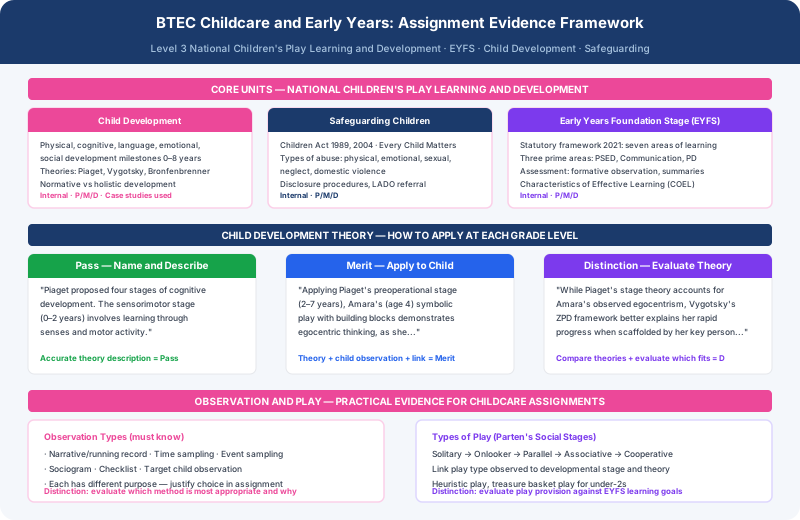
BTEC National Children's Play, Learning and Development: Unit Structure
BTEC National Children's Play, Learning and Development (CPLD) is available as an Extended Certificate (360 guided learning hours, one A-level equivalent) and an Extended Diploma (1,080 guided learning hours, three A-level equivalent). It replaces the former BTEC National Health and Social Care (Children and Young People) pathway and is specifically designed for students pursuing early years and childcare careers at Level 3.
The qualification is assessed entirely through internal coursework, all units are tutor-set, centre-marked, internally verified, and Pearson-moderated. There are no external examinations in BTEC National CPLD. One resubmission is available on each unit if the initial submission receives a Referral, which makes thorough pre-submission criterion checking particularly important. Unlike BTEC National Sport or Business, there is no external assessment unit that creates an automatic ceiling on resubmission availability.
Core units across the qualification include: Child Development (physical, intellectual, language, emotional, and social development from birth to 8 years, using the PIES/SPICE framework, developmental milestones, and theoretical perspectives including Piaget, Vygotsky, Bronfenbrenner, and Bowlby); Development and Learning in Early Years Settings (the EYFS statutory framework, planning for learning, observation and assessment methodologies, enabling environments); Working with Families and Professional Partners (partnership working, safeguarding, multi-agency collaboration, family support); and Keeping Children Safe (safeguarding legislation, types of abuse, disclosure procedures, Children Act 1989 and 2004, Working Together to Safeguard Children 2018).
Placement-based evidence is a significant component of BTEC National CPLD. Students are typically required to undertake supervised placement in early years settings, nurseries, children's centres, childminder settings, or primary school Reception classes, and to produce observation records, reflective accounts, and professional practice evidence from that placement. The placement hours requirement and the evidence format for placement-based criteria are specified in the Assignment Brief and must be followed exactly.
BTEC Childcare Unit 1: Human Lifespan Development Assignment Help
Child Development is the theoretical foundation unit of BTEC National CPLD and the unit most frequently referenced across other unit assignments. It requires students to demonstrate knowledge of developmental patterns across all domains from birth to 8 years, the theories that explain development, and the factors that influence developmental outcomes.
The developmental domains assessed include: physical development (gross and fine motor skill development, the cephalocaudal and proximodistal principles, growth patterns, and the role of nature and nurture); cognitive development (perception, attention, memory, problem-solving, and the development of language); language development (from pre-linguistic communication through babbling, first words, telegraphic speech, and the emergence of grammatical complexity, assessed against Chomsky's nativist theory and Skinner's behaviourist theory); emotional development (attachment theory: Bowlby's maternal deprivation hypothesis, Ainsworth's Strange Situation and attachment types, self-concept, self-esteem, and emotional regulation); and social development (socialisation, Parten's stages of play, peer relationships, and the development of moral reasoning using Kohlberg's stages).
Pass criteria require accurate description of development across the specified domains and age ranges. The most common Pass failure is incomplete domain coverage, addressing physical and cognitive development but omitting language or social development within the required age range. Every domain specified in the criterion must be explicitly addressed.
Merit criteria require analysis of factors affecting development, applying a factor (poverty, disability, early attachment experience, bilingualism) to explain how and why it produces a specific developmental outcome in a specific domain. The analysis must explain the mechanism, not merely assert a correlation. Stating that poverty negatively affects development is a Pass-level observation; explaining that poverty reduces access to nutritious food, which affects brain development in the first 1,000 days through limiting synaptic pruning efficiency, and that it also reduces access to stimulating play materials and adult interaction time that cognitive development research identifies as critical for language acquisition, is Merit-level analysis.
BTEC Childcare Safeguarding Assignment Help
Safeguarding is a high-stakes unit in BTEC National CPLD because safeguarding knowledge and procedural competence are direct employment requirements for every early years practitioner. The Assignment Brief for this unit typically requires students to demonstrate knowledge of abuse types, relevant legislation, disclosure procedures, and the multi-agency partnership framework for child protection.
The key legislative framework for child safeguarding in England includes: the Children Act 1989 (paramountcy principle, the child's welfare is the paramount consideration; parental responsibility; care and supervision orders); the Children Act 2004 (s.47 duty to investigate where a child is at risk of significant harm; the establishment of Local Safeguarding Children Boards, now replaced by Safeguarding Children Partnerships under the Children and Social Work Act 2017); Working Together to Safeguard Children 2018 (the statutory guidance document governing inter-agency working and safeguarding procedures in England); and the EYFS statutory framework 2021 (which places specific safeguarding obligations on registered early years providers, including designated safeguarding lead requirements and staff-to-child ratios).
Types of abuse that students must know for Pass criteria: physical abuse, emotional abuse, sexual abuse, neglect, and the additional categories recognised in the guidance including child criminal exploitation (CCE), child sexual exploitation (CSE), female genital mutilation (FGM), and domestic abuse. Each type has specific indicators (physical signs and behavioural signs) that practitioners must be able to identify. The criteria typically require students to describe indicators as well as definitions.
Merit criteria require analysis of how legislation and procedures protect children, explaining the mechanism by which the legislative framework creates duties to act and structures the multi-agency response. Distinction criteria require evaluation: critically assessing where the safeguarding system has failed, using evidence from serious case reviews (now termed Child Safeguarding Practice Reviews under the Children and Social Work Act 2017), identifying systemic weaknesses, and evaluating the effectiveness of reforms introduced in response. The cases of Victoria Climbié (Laming Report, 2003), Baby P (Haringey LSCB serious case review, 2009), and Daniel Pelka (Coventry LSCB serious case review, 2013) provide the evidence base for Distinction-level critical evaluation of safeguarding system failures and subsequent legislative reform.
Early Years Foundation Stage (EYFS): Assignment Guidance for BTEC Students
The Early Years Foundation Stage is the statutory framework governing the learning, development, and welfare of all children from birth to 5 in Ofsted-registered settings in England. For BTEC CPLD students, the EYFS is both subject knowledge content and the professional framework within which their placement evidence must be situated. Assignments that require EYFS knowledge expect students to demonstrate familiarity with the current framework (revised 2021), not earlier versions.
The EYFS framework organises learning and development into seven areas: three prime areas (Communication and Language; Physical Development; Personal, Social and Emotional Development: PSED) and four specific areas (Literacy; Mathematics; Understanding the World; Expressive Arts and Design). The prime areas are given priority in the 0–2 age range because they are foundational to all other learning. Pass criteria for EYFS units require accurate description of the areas and the rationale for the prime/specific distinction.
The EYFS Characteristics of Effective Learning (COEL): Playing and Exploring, Active Learning, and Creating and Thinking Critically, describe how children learn rather than what they learn. BTEC assignments frequently ask students to apply the COEL to observed or described child behaviours. The Pass standard requires accurate identification of which characteristic of effective learning a behaviour exemplifies; the Merit standard requires analytical explanation of how the enabling environment or adult interaction promoted that characteristic; the Distinction standard requires evaluation of the provision, what worked well, what could be improved, and why, with reference to research on effective early years pedagogy.
Planning in the EYFS context, including short-term planning documents (daily or weekly plans), medium-term planning, and the Continuous Provision approach, is assessed in several BTEC CPLD units. Students must understand the relationship between observation, assessment, and planning (the observe–assess–plan cycle) and be able to design developmentally appropriate activities linked to EYFS areas of learning. Distinction-level planning evidence includes evaluation of how well the planned activity met the child's identified developmental needs and recommendations for next steps.
Child Observation Methods: How to Write Observation Evidence for BTEC CPLD
Child observation is a core practical skill assessed throughout BTEC National CPLD, and observation records form a significant part of the placement-based portfolio evidence. Students must be able to plan, conduct, record, and analyse observations using appropriate methodology, and must understand the purpose, strengths, and limitations of each observation method.
The principal observation methods used in early years practice and assessed in BTEC CPLD include: narrative observation (also called running record), a detailed, time-stamped written record of everything a child does and says during an observation period, written in the present tense, without interpretation. Used to capture a rich, holistic picture of child behaviour across all developmental domains. Time sampling, recording what a child is doing at regular time intervals (e.g., every five minutes for 30 minutes), producing a pattern of activity over time. Useful for identifying how a child uses different areas of provision throughout a session. Event sampling, recording a specific behaviour each time it occurs, along with the antecedent, behaviour, and consequence (ABC format). Used for tracking a target behaviour such as a challenging interaction or communication attempt. Sociogram, mapping social interactions between children to identify social patterns and friendship networks. Checklist observation, observing whether specific development items on a developmental checklist have been achieved, useful for progress monitoring against developmental milestones.
Pass criteria for observation units require correctly formatted, non-interpretive observation records using an appropriate method. A common Pass failure is mixing observation and interpretation, writing "Amir seemed to feel upset" (interpretation) rather than "Amir's eyes filled with tears and he put his hands over his face" (observable behaviour). Observation records at Pass level describe what can be seen and heard, without inference about internal states.
Merit criteria require analysis of the observation findings: linking the observed behaviour to developmental theory, identifying the developmental domain and stage, and explaining what the observation reveals about the child's current development. Distinction criteria require evaluation of the observation methodology: why was this observation method the most appropriate for the purpose? What were its limitations in this context? What did it not capture that an alternative method would have? What do the combined observations across the placement period suggest about the child's developmental needs, and what provision would best support those needs?
Legislation, Policy, and Safeguarding in BTEC CPLD: Distinction Evidence Standards
Legislation knowledge in BTEC CPLD assignments follows the same three-tier evidence standard as developmental theory: Pass criteria require students to name and describe the relevant legislation accurately; Merit criteria require analytical application — explaining how the legislation creates specific obligations for practitioners and how those obligations translate into practice in an early years setting; Distinction criteria require evaluation of legislative effectiveness, including where legislation has failed to protect children and what subsequent reforms were introduced in response.
The SEND Code of Practice 2015 (updated 2020) is a mandatory framework for BTEC CPLD units addressing inclusion and special educational needs. Part 3 of the Code establishes the Assess-Plan-Do-Review cycle as the graduated response to SEND: the setting must assess the child's needs through observation and professional discussion, plan targeted provision, implement the plan, and review its impact on the child's outcomes. Pass criteria require describing the cycle accurately. Merit requires applying it to a specific child case scenario — explaining what assessment information would be gathered, what the plan would target, and how success would be measured. Distinction requires evaluating the cycle's limitations: the EHCP threshold criteria (where needs cannot be met by the setting alone, requiring an Education, Health and Care Plan under the Children and Families Act 2014) and the evidence that funding constraints create significant variation in SEND provision quality across local authorities, which is documented in Ofsted and CQC joint SEND inspection reports.
The legislative reform chain in child safeguarding provides the evidential basis for Distinction-level critical evaluation. The death of Victoria Climbié in 2000 and the subsequent Laming Report (2003) identified systemic failures in multi-agency communication, professional deference, and cultural assumptions that distorted professional judgement — direct recommendations produced the Children Act 2004, which established Every Child Matters, the Common Assessment Framework, and the duty to promote cooperation between agencies under s.10. The death of Peter Connelly (Baby P) in 2007 and the Haringey LSCB serious case review (2009) identified that despite the reforms following Laming, professional deference to authority figures and multiple missed contact opportunities persisted. The Munro Review of Child Protection (2011) identified systemic risk-aversion and compliance culture as unintended consequences of the post-Laming procedural reforms, recommending a shift from compliance-based to child-centred professional practice. The Children and Social Work Act 2017 replaced Local Safeguarding Children Boards with Safeguarding Children Partnerships and replaced serious case reviews with Child Safeguarding Practice Reviews, with a national panel to identify systemic patterns across cases. A Distinction response does not merely list these reforms — it evaluates the pattern they reveal: each reform addresses a specific failure mode, but the recurrence of safeguarding failures indicates that structural and cultural factors resist procedural solutions alone.
Ofsted inspection reports are a legitimate and assessor-valued evidence source for Distinction in BTEC CPLD. CQC and Ofsted's joint SEND area inspections document provision quality across local areas. Ofsted's annual report provides sector-wide evidence on safeguarding and early years quality. Referencing specific Ofsted findings — for example, the proportion of early years settings judged inadequate on safeguarding — demonstrates that the evaluation is grounded in published evidence rather than theoretical speculation, which is the Distinction standard in CPLD legislation and policy units.
How does the application of child development theory to observed or simulated child behaviours determine the grade in BTEC Childcare assignments? Pass requires naming and describing the theory correctly. Merit requires applying it specifically to the observed behaviour, connecting what was seen to the theoretical mechanism that explains it. Distinction requires evaluating whether the theory is the most adequate explanation for this child in this context, and considering whether an alternative theoretical perspective would provide a better account. The child's specific behaviour is the evidence base that all three levels of response must engage with.
BTEC CPLD and Early Years Qualifications Progression: What Comes Next
BTEC National CPLD Extended Diploma is accepted by universities as a route to early childhood studies, education studies, primary education (with QTS), social work, nursing, and health and social care degree programmes. The UCAS tariff at D*D*D is 168 points, equivalent to three A* grades at A-level. Universities offering early childhood studies degrees or foundation degrees in childcare practice are the primary higher education routes from BTEC CPLD.
For those seeking employment entry rather than higher education, BTEC National CPLD Level 3 satisfies the Level 3 childcare qualification requirement for working as a room leader or key person in an Ofsted-registered nursery setting (subject to individual employer requirements and DBS clearance). The qualification's EYFS content and placement component are directly relevant to early years employment contexts.
The Level 5 Early Childhood Studies Foundation Degree, delivered by many further education colleges in partnership with universities, is the HND-equivalent progression route for those who complete BTEC CPLD at Level 3 and wish to progress within early years practice without moving to a full undergraduate degree programme. It provides route to Early Years Teacher Status (EYTS) and Senior Practitioner roles.
For grading and assessment guidance: BTEC grading criteria explained, BTEC resubmission guide, and How to achieve Distinction in BTEC assignments.
Does BTEC National Children's Play, Learning and Development have any external examinations?
No. BTEC National Children's Play, Learning and Development is assessed entirely through internal coursework. All units are tutor-set, centre-marked, internally verified, and Pearson-moderated. There are no Pearson-set external examinations in this qualification. One resubmission is available on each unit if the initial submission receives a Referral. Check the Assignment Brief for each unit to confirm the assessment type, internally assessed units are the default throughout this qualification.
Which child development theories are most important for BTEC CPLD assignments?
Core theories for BTEC CPLD include: Piaget's stages of cognitive development (sensorimotor, preoperational, concrete operational, formal operational); Vygotsky's Zone of Proximal Development and scaffolding; Bowlby's attachment theory and Ainsworth's attachment types; Bronfenbrenner's ecological systems theory; Skinner's operant conditioning and Bandura's social learning theory (for behaviour development); Chomsky's nativist and Skinner's behaviourist theories of language acquisition; and Parten's stages of social play. Specific units may require additional theories, the Assignment Brief will indicate which theoretical frameworks are relevant.
What is the EYFS and why is it important in BTEC Childcare assignments?
The Early Years Foundation Stage (EYFS) is the statutory framework governing the learning, development, and welfare of all children from birth to 5 in Ofsted-registered early years settings in England. It is important in BTEC CPLD assignments because it is the professional framework within which all early years practice operates. BTEC assignments require students to plan activities and evaluate provision using EYFS areas of learning, apply the Characteristics of Effective Learning, and understand the welfare requirements including safeguarding obligations. The current framework is the 2021 revised version, use this, not earlier versions.
How should a child observation record be written for BTEC CPLD?
A BTEC CPLD observation record must use the appropriate format for the chosen observation method (narrative, time sampling, event sampling, sociogram, or checklist), include the child's age, date, time, and setting, and record observable behaviour without interpretation. For narrative observations, write in the present tense and describe only what can be seen or heard, avoid inferring internal states. After the observation record, a separate analysis section links the observed behaviour to developmental theory and milestones. The observation itself must remain purely descriptive; interpretation belongs in the analysis section.
Need expert help with your ATHE assignment?
Get Help NowCommon Questions
Is this service specific to BTEC qualifications?
Yes. We specialise exclusively in Pearson BTEC qualifications. Our writers are selected for their specific knowledge of BTEC units, marking criteria, and grade descriptors — not generic academic writing.
Will my assignment be plagiarism free?
Every assignment is written from scratch and run through Turnitin before delivery. You receive a copy of the originality report alongside your completed work.
How quickly can you complete my assignment?
Standard turnaround is 5–7 days. For urgent orders we offer 24-hour and 48-hour expedited delivery at an additional cost. Contact us to confirm availability for your deadline.
What if I'm not happy with the work?
We offer unlimited free revisions within 14 days of delivery. If we cannot meet your requirements after multiple revisions, we offer a full refund — no questions asked.