
BTEC IT assignment help covers Level 3 National Information Technology, Level 4 HNC Computing, and Level 5 HND Computing across programming, networking, database systems, cybersecurity, and systems analysis units. IT assignments combine practical technical evidence, working code, network configurations, database implementations, with analytical written content explaining design decisions and evaluating technical choices. The grade boundary between Merit and Distinction in BTEC IT consistently falls at the point where the student moves from producing a functional technical solution to critically evaluating it against alternatives. This service provides criterion-specific guidance for both technical and written components of BTEC IT assignments.
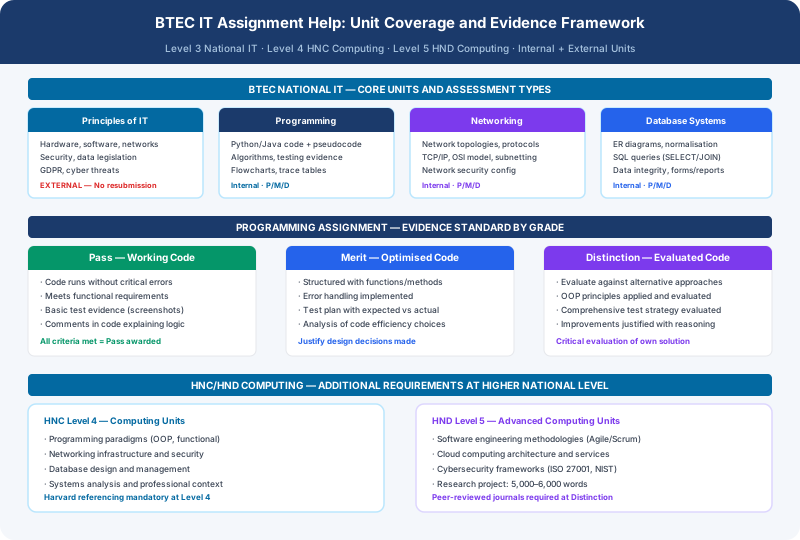
BTEC National IT: Unit Structure, External Assessment, and Core Content
BTEC National Information Technology is available as an Extended Certificate, a Diploma, and an Extended Diploma at Level 3. The qualification is designed to prepare students for higher education in computing or IT-related employment, and it combines theoretical understanding of IT systems with practical technical skills.
Principles of IT is the core external assessment unit at BTEC National IT on most qualification sizes. It is a Pearson-set, Pearson-marked examination covering hardware components and their functions, software types and licencing, network topologies and protocols, cybersecurity threats and mitigations, data legislation (GDPR 2018, Computer Misuse Act 1990, Data Protection Act 2018), and emerging technologies. There is no resubmission for this unit, students who fail must resit in the next Pearson assessment window. Preparation requires command word analysis, timed response practice, and stimulus material reading skills, not merely subject knowledge.
Internal assessment units at BTEC National IT include Programming (algorithm design, programming language syntax, code implementation, testing), Networking (network design, protocol configuration, network security), Website Development (front-end and back-end development, user experience design, testing), Database Systems (relational database design, SQL, normalisation), and IT Systems Security (threat analysis, security policy design, vulnerability assessment). Each of these carries the standard one-resubmission rule for internal assessment.
At BTEC National IT, assessment evidence includes both written reports and practical technical artefacts. A programming assignment will require submitted code, test evidence (screenshots or test logs), and a written analysis document. A networking assignment may require a network design diagram, justification of design decisions, and configuration screenshots as evidence of implementation. Follow the Assignment Brief format requirements precisely, submitting only code without accompanying analysis will not meet criteria that require analytical or evaluative evidence.
BTEC IT Programming Assignments: Evidence Standards at Pass, Merit, and Distinction
Programming units appear at every BTEC IT and Computing level, and they are among the most frequently referred units because students consistently focus on producing working code while neglecting the analytical and evaluative written evidence the higher criteria require.
The Pass standard for a programming assignment requires: working code that meets the functional requirements of the task (the program runs without critical errors and performs the specified functions); pseudocode or a flowchart showing the algorithm design before implementation; code with meaningful comments explaining the logic at key points; and test evidence showing the program has been tested with valid, invalid, and boundary data, with expected versus actual outputs recorded. A program that works but has no test evidence, or that has not been designed algorithmically before coding, will not meet all Pass criteria.
The Merit standard requires analysis of the design and implementation. The student must justify design decisions: why was this data structure chosen rather than an alternative? Why was this control structure (iteration, selection) appropriate for the problem? How was the code structured to promote maintainability and readability (functions, classes, meaningful variable names)? A structured test plan that systematically tests normal operation, boundary conditions, and error handling, and that records actual outcomes against predicted outcomes, is the testing evidence expected at Merit level.
The Distinction standard requires critical evaluation of the solution. This means comparing the implemented solution against alternative approaches (different algorithms, different data structures, different programming paradigms) and making a justified argument for why the chosen approach is appropriate or, where it is not optimal, what an improved approach would be and why. At HNC and HND level, evaluation additionally includes assessment of whether object-oriented principles (encapsulation, inheritance, polymorphism) have been applied appropriately and an analysis of the solution's scalability and performance characteristics.
A critical failure mode specific to programming assignments: students submit the code but do not submit the written analysis document, or submit only a brief description of what the code does. The written analysis is where Merit and Distinction criteria are satisfied. Code alone, however sophisticated, does not demonstrate the analytical and evaluative competence the higher criteria require.
BTEC IT Networking Assignments: Design, Protocol, and Security Evidence
Networking units at BTEC National IT and HNC/HND Computing require students to demonstrate both theoretical knowledge of network technology and practical ability to design, configure, and evaluate network solutions. The core technical content includes network topologies (star, mesh, ring, bus, hybrid), the OSI model and TCP/IP model, IP addressing and subnetting, routing protocols (static routing, OSPF, RIP), switching (VLANs, Spanning Tree Protocol), wireless networking (802.11 standards, SSID, WPA3), and network security (firewalls, IDS/IPS, VPN, DMZ architecture).
Pass criteria for networking assignments require accurate descriptions of network components, correct application of IP addressing and subnetting, and functional network designs that meet stated requirements. A network design diagram must use recognised notation (Cisco icons or generic network symbols), show all components, label IP addresses and subnet masks on each interface, and document the routing configuration. A design that omits addressing or does not show the routing plan will not fully satisfy Pass criteria.
Merit criteria require analysis of design decisions. For each significant design choice, the choice of topology, the subnetting scheme, the security architecture, the Merit standard requires a reasoned explanation: why this topology is appropriate for the requirement (e.g., star topology because it provides fault isolation and centralised management), and why an alternative would be less suitable. The analysis must be specific to the scenario in the assignment, not a generic comparison of network topologies copied from a textbook.
Distinction criteria require evaluation of the network design's performance, security, and scalability. A Distinction-level networking assignment evaluates the security posture of the design: identifies the threats the network is exposed to, explains how the security controls in the design mitigate those threats, and identifies residual vulnerabilities with justified recommendations for further mitigation. Referencing security frameworks such as the NCSC Cyber Essentials scheme or ISO/IEC 27001 in the evaluation satisfies the academic sourcing expectation at HNC and HND level.
BTEC IT Database Assignments: Relational Design, SQL, and Evaluation Evidence
Database Systems units require students to design, implement, and evaluate relational database solutions. The technical content covers entity-relationship modelling (ER diagrams, entities, attributes, primary keys, foreign keys, relationships and their cardinality), database normalisation (first, second, and third normal form), SQL (SELECT queries including WHERE, JOIN, GROUP BY, HAVING, ORDER BY; INSERT, UPDATE, DELETE; CREATE TABLE with appropriate data types and constraints), and database management system (DBMS) configuration including user access control, indexing, and backup procedures.
Pass criteria require: a correctly drawn ER diagram for the specified scenario that identifies all entities, their attributes, primary keys, and the relationships between entities with correct cardinality notation; a normalised relational schema at third normal form; a correctly implemented database with tables, data, and working SQL queries that meet the functional requirements. The most common Pass failure is a normalised schema that still contains partial or transitive dependencies, full normalisation must be demonstrated, not merely stated.
Merit criteria require analysis of the database design. This means justifying normalisation decisions: why was this table structure preferred over an alternative? What are the performance implications of the chosen normalisation level? How do the indexing decisions affect query performance? A Merit-level SQL section includes complex multi-table JOIN queries with explanation of the join type chosen (INNER JOIN vs LEFT JOIN) and why it is appropriate for the query requirement.
Distinction criteria require evaluation of the database solution's fitness for purpose: does the schema support the identified business requirements? What are the limitations of the current design in terms of scalability, data integrity, or query performance, and how would these be addressed in a production implementation? At HNC and HND level, evaluation of DBMS selection (why MySQL rather than PostgreSQL or Microsoft SQL Server for this use case) with reference to technical literature meets the Distinction sourcing and analytical depth expectation.
BTEC IT and Computing at HNC/HND: Higher National Level Requirements
BTEC HNC Computing (Level 4) and HND Computing (Level 5) extend the National-level technical content to professional and organisational contexts, with Harvard referencing mandatory throughout. The qualification framework at Higher National level expects students to situate technical analysis within industry and academic literature rather than treating IT as purely a practical subject.
Core HNC Computing units include: Programming Paradigms (procedural, object-oriented, functional, and event-driven programming, comparative analysis of paradigms in addition to implementation); Networking Infrastructure (enterprise network design, network services such as DNS, DHCP, Active Directory, cloud infrastructure); Database Design and Management (advanced SQL, stored procedures and triggers, NoSQL databases and when they are appropriate); and Systems Analysis (requirements capture, UML modelling, SDLC methodologies, waterfall, agile, spiral, and their comparative merits).
HND Computing adds: Software Engineering (Agile methodology in depth, DevOps practices, version control with Git, CI/CD pipelines); Cloud Computing (AWS, Azure, and GCP service models: IaaS, PaaS, SaaS, cloud architecture patterns, cost optimisation, and security considerations); Cybersecurity (penetration testing methodologies, threat modelling, security frameworks including ISO 27001 and NIST Cybersecurity Framework, incident response); and the mandatory Computing Research Project.
The shift from BTEC National to HNC/HND IT requires a change in writing approach. National-level responses can focus heavily on practical demonstration with brief written justification. HNC and HND responses are expected to read as professional technical reports: formal register, Harvard-referenced sources, structured argumentation, and critical evaluation that engages with the academic and industry literature. A response at HNC level that references only textbooks without journal papers, and that presents a technical solution without evaluating it against alternatives or limitations, will typically achieve Merit at best.
BTEC IT Distinction: Evaluating Technical Solutions Against Standards and Alternatives
The Distinction standard in BTEC IT — evaluate the technical solution against alternatives, identify limitations, and make justified recommendations — applies across all technical domains, but the specific evaluation frameworks and standards that constitute Distinction evidence differ by domain. Knowing which frameworks to reference demonstrates the professional technical awareness that distinguishes Distinction from Merit at every level.
Programming: Distinction at HNC and HND level requires algorithmic complexity evaluation using Big O notation — not just producing a working implementation but evaluating whether the chosen algorithm's time complexity (O(n), O(n log n), O(n²), O(2ⁿ)) and space complexity are appropriate for the expected data scale. A Distinction response compares the implemented algorithm against at least one alternative, explains why the chosen approach's complexity profile makes it more or less suitable for the specific problem size, and recommends the optimal approach with justification. For object-oriented design, SOLID principles evaluation provides the structured assessment framework: Single Responsibility Principle (each class has one reason to change); Open/Closed Principle (open for extension, closed for modification); Liskov Substitution Principle (derived classes must be substitutable for base classes); Interface Segregation Principle (specific interfaces preferred over general ones); Dependency Inversion Principle (depend on abstractions, not concrete implementations). Evaluating whether the implemented design complies with SOLID principles — and identifying where it does not and what the consequences are — meets the Distinction evaluation standard for OOP design quality at HNC level.
Networking: Distinction requires systematic security threat analysis using a recognised threat taxonomy. STRIDE — Spoofing identity, Tampering with data, Repudiation, Information Disclosure, Denial of Service, Elevation of Privilege — provides a structured framework for identifying the threats a network design is exposed to. A Distinction-level networking assignment maps each STRIDE threat category to the specific network scenario, evaluates how the security controls in the proposed design mitigate each threat, and identifies residual vulnerabilities with justified remediation recommendations. Evaluating the design's alignment with the NCSC Cyber Essentials scheme (five controls: boundary firewalls, secure configuration, access control, malware protection, and patch management) provides an assessor-recognised compliance framework. At HNC and HND level, referencing ISO/IEC 27001 information security management system requirements — particularly the Annex A controls relevant to the network design — demonstrates the standards depth Distinction requires.
Databases: Distinction requires comparative DBMS evaluation — justifying the choice of database management system against the specific requirements using technical and operational criteria. The evaluation should compare the selected DBMS against at least one alternative on dimensions including performance (read/write throughput, query optimisation capabilities), scalability (horizontal vs vertical scaling characteristics), ACID compliance (Atomicity, Consistency, Isolation, Durability), licensing cost, and community/vendor support. Where a NoSQL approach might be more appropriate than a relational model, Distinction requires applying CAP theorem reasoning: CAP theorem states that a distributed data store can guarantee at most two of Consistency, Availability, and Partition tolerance simultaneously — understanding which two properties are prioritised in different NoSQL categories (document stores, key-value stores, wide-column stores, graph databases) demonstrates the database architecture awareness Distinction at HNC/HND level requires.
Systems Analysis: Distinction requires SDLC methodology evaluation — comparing waterfall, agile (Scrum/Kanban), and spiral methodologies against the specific project characteristics and recommending the most appropriate approach with justification. Waterfall suits projects with stable, well-defined requirements and low client involvement needs; agile suits projects with evolving requirements, high client interaction, and iterative delivery priorities; spiral suits high-risk projects where prototyping reduces requirements uncertainty before committing to full development. Referencing IEEE 830 (software requirements specification standard) and IEEE 1016 (software design description standard) demonstrates the professional standards awareness that BTEC IT Distinction at HNC level expects.
What evidence do BTEC IT examiners look for to award Distinction at Level 3, 4, and 5? At National level, Distinction requires evaluating your own technical solution, comparing it against alternatives and identifying its limitations with justified recommendations. At HNC, Distinction additionally requires Harvard-referenced academic and industry sources. At HND, Distinction requires critical engagement with the academic debate around the technology: evaluating competing approaches, frameworks, or methodologies with reference to research literature, not merely applying best-practice guidelines.
BTEC IT vs Computer Science A-Level: What Employers and Universities See
BTEC National IT and Computer Science A-level are both Level 3 qualifications that generate UCAS points for computing degree entry, but they emphasise different competences. Computer Science A-level develops theoretical computer science foundations, algorithms, data structures, computational thinking, programming theory, assessed through written examinations. BTEC National IT develops applied technical skills in networking, databases, programming, and cybersecurity through practical coursework portfolios, alongside theoretical knowledge assessed through the Principles of IT external examination.
Universities offering BEng, BSc, or MEng programmes in Computer Science, Software Engineering, Cybersecurity, or Networking accept both qualifications at equivalent UCAS point values, though individual entry requirements vary. BTEC IT graduates often report stronger day-one practical competence at university, while A-level Computer Science graduates may have stronger formal algorithmic reasoning foundations. Both are valid routes to higher education and industry roles in technology.
For level-specific guidance: BTEC National assignment help, BTEC HNC assignment help, and BTEC grading criteria explained.
Does BTEC National IT have an external examination?
Yes. Principles of IT is an externally assessed unit on most BTEC National IT qualification sizes. It is a Pearson-set, Pearson-marked examination with no resubmission route. Content covers hardware, software, networking, cybersecurity, and data legislation including GDPR. Students who fail must resit in the next Pearson assessment window. All other core units at BTEC National IT are internally assessed by the centre, with one resubmission available if referred.
What coding language is used in BTEC IT programming assignments?
The programming language used in BTEC IT assignments is determined by the centre, not by Pearson. Most BTEC National IT programming units use Python as the primary language, though some centres use Java, C#, or JavaScript. The Assignment Brief will specify the language requirement. At HNC and HND Computing, programming paradigm units may require implementation in multiple languages to demonstrate comparison between paradigms (e.g., Python for procedural/OOP and Haskell or JavaScript for functional programming).
How do I show test evidence for a BTEC IT programming assignment?
Test evidence for BTEC IT programming assignments requires a formal test plan, a table showing each test case, the input data used (valid, invalid, and boundary values), the expected output, the actual output, and the pass/fail result. Screenshots showing the program running with each test input and displaying the actual output should accompany the test table. A test plan without screenshots is incomplete; screenshots without a test plan do not demonstrate systematic testing. At Merit and Distinction level, test plans should include error-handling test cases and explanation of why each test type was selected.
Can I reference websites in BTEC IT assignments at HNC level?
At HNC Level 4, academic sources are expected: textbooks, peer-reviewed journal articles, and authoritative technical publications such as NCSC guidance, IEEE standards, or ISOC documentation. General websites (Wikipedia, vendor marketing pages) are not acceptable as academic sources for Merit or Distinction criteria. Professional industry documentation: AWS, Microsoft, Cisco technical documentation, is acceptable when used to support specific technical claims, but should be supplemented by academic sources in analytical and evaluative sections.
Need expert help with your ATHE assignment?
Get Help NowCommon Questions
Is this service specific to BTEC qualifications?
Yes. We specialise exclusively in Pearson BTEC qualifications. Our writers are selected for their specific knowledge of BTEC units, marking criteria, and grade descriptors — not generic academic writing.
Will my assignment be plagiarism free?
Every assignment is written from scratch and run through Turnitin before delivery. You receive a copy of the originality report alongside your completed work.
How quickly can you complete my assignment?
Standard turnaround is 5–7 days. For urgent orders we offer 24-hour and 48-hour expedited delivery at an additional cost. Contact us to confirm availability for your deadline.
What if I'm not happy with the work?
We offer unlimited free revisions within 14 days of delivery. If we cannot meet your requirements after multiple revisions, we offer a full refund — no questions asked.