
BTEC Engineering assignment help covers Level 3 National Engineering, Level 4 HNC Engineering, and Level 5 HND Engineering across the four principal disciplines: Mechanical, Electrical and Electronic, Civil, and Manufacturing Engineering, plus specialist pathways including Aerospace, Automotive, and Building Services. Engineering assignments combine technical calculation evidence, laboratory report writing, and design justification documents, and the grade boundary between Pass and Merit consistently falls at the point where numerical results are interpreted in context rather than simply presented. This service provides criterion-specific guidance for both the written and the technical components of BTEC Engineering assignments.
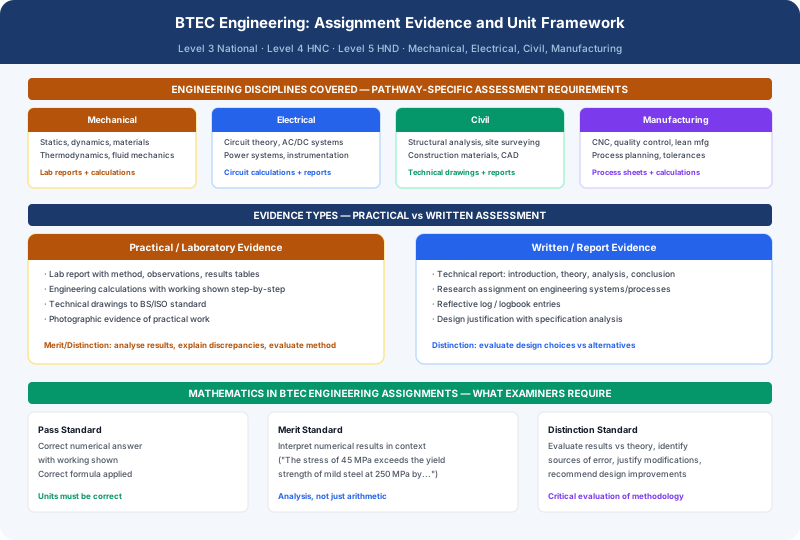
BTEC Engineering at National Level 3: Unit Structure and Assessment Mix
BTEC National Engineering is available as an Extended Certificate (360 guided learning hours, one A-level equivalent), a Diploma (720 guided learning hours), or an Extended Diploma (1,080 guided learning hours, three A-level equivalent). The qualification covers a broad engineering foundation at Extended Certificate and Diploma level, with the Extended Diploma introducing specialist pathway units across Mechanical, Electrical, Civil, or Manufacturing disciplines.
Core units common across most BTEC National Engineering programmes include: Engineering Principles (statics and dynamics, materials science, thermodynamics, and electrical principles, the foundational technical unit); Delivery of Engineering Processes Safely as a Team (health and safety legislation, risk assessment, safe working practice, and engineering process documentation); Engineering Product Design and Manufacture (design specification analysis, material selection, manufacturing processes, and quality control); and Applied Commercial and Quality Principles in Engineering (quality management systems, commercial operations in engineering businesses).
The assessment mix at BTEC National Engineering is predominantly internal. However, some programmes include externally assessed units, particularly Engineering Principles at certain qualification sizes, which Pearson sets and marks. Students should verify whether Engineering Principles is internally or externally assessed on their specific programme, as the resubmission rules differ: internally assessed units permit one resubmission; externally assessed units do not.
Evidence formats in BTEC National Engineering are more varied than in written-subject BTECs. Acceptable evidence includes laboratory reports with data tables and analysis, engineering drawings produced to BS 8888 or ISO standard, calculation sheets with full working shown, design portfolios, photographic evidence of practical work completed, and reflective logs. The specific evidence format required for each task is specified in the Assignment Brief, follow it exactly.
Engineering Principles: Technical Calculations and What Examiners Require
Engineering Principles is the core technical unit at BTEC National Engineering and covers the foundational mathematics and science underpinning all four engineering disciplines. The topics assessed include: static equilibrium (resolving forces, moments and couples, centre of gravity); dynamics (Newton's laws, kinematics, momentum, energy, work, and power); materials (stress, strain, Young's modulus, material properties, and selection criteria); thermodynamics (heat transfer, specific heat capacity, latent heat, gas laws, and thermodynamic cycles); and electrical principles (Ohm's law, series and parallel circuits, power, Kirchhoff's laws, AC circuit theory).
The Pass standard for engineering calculations requires the correct answer with full working shown, the correct formula applied, and the correct units throughout. A numerical answer without working shown is not sufficient evidence at Pass, even if the answer is correct, assessors check the method, not merely the result. Units must be dimensionally consistent: an answer to a stress calculation expressed in Newtons rather than Pascals (N/m²) will not meet the criterion, even if the numerical value is correct.
The Merit standard requires contextual interpretation of calculated results. The distinction between Pass and Merit is the difference between calculating a value and explaining what the value means in the engineering context. A Merit response to a stress calculation presents the calculated stress value, compares it against the yield strength and ultimate tensile strength of the material, and explains the implications for the design, whether the component will behave elastically or plastically under that load, and whether the calculated safety factor meets the required standard.
The Distinction standard requires evaluation of the engineering analysis and justified recommendations. For a dynamics problem, Distinction involves evaluating the assumptions made in the analysis (for example, the assumption of frictionless surfaces or rigid body behaviour), assessing the effect of those assumptions on the accuracy of the results, identifying sources of experimental error in a laboratory context, and recommending design modifications with justification based on the analysis. This is engineering judgement, not engineering arithmetic.
BTEC Engineering Laboratory Reports: Structure and Grading Standards
Laboratory report writing is a core evidence requirement across multiple BTEC Engineering units. A BTEC Engineering lab report follows a structured format that mirrors the professional engineering report used in industry and academia: Title, Objective, Theory, Method/Procedure, Results, Analysis and Discussion, Conclusion, and References (where applicable).
Objective: State the purpose of the experiment precisely, what is being measured, what relationship is being investigated, or what property is being determined. "To measure resistance" is insufficiently specific. "To investigate the relationship between temperature and resistance in a NTC thermistor and to determine the temperature coefficient of resistance over the range 20°C to 80°C" meets the Pass standard for a clearly stated objective.
Theory section: State the theoretical principles underlying the experiment. For a Hooke's Law tensile testing experiment, this means stating the law (F = ke, where F is force, k is the spring constant, and e is extension), defining each variable, and stating the conditions under which the law holds (elastic limit not exceeded). The Pass standard requires accuracy; the Merit standard requires derivation or explanation of why the relationship holds.
Results: Present data in a clearly labelled table with units in the column headers, not repeated in each cell. Derived values (calculated from raw data) should be distinguished from measured values. Graphs should have labelled axes with units, an appropriate scale, correctly plotted data points, and a line of best fit where appropriate. The gradient of the line of best fit should be calculated and the physical quantity it represents identified.
Analysis and Discussion: This is the section where Merit and Distinction criteria are satisfied. Analysis requires interpreting the results: does the data confirm the theoretical prediction, and to what extent? What is the percentage error between the experimental result and the theoretical value? Identify sources of experimental error systematically, random errors (reading errors, instrument precision) versus systematic errors (calibration offsets, unaccounted heat loss). Distinction requires evaluating the methodology: how could the experimental design be improved to reduce error? What assumptions were made and how do they affect confidence in the results?
BTEC Engineering at HNC Level 4: Engineering Design and Professional Context
BTEC HNC Engineering (Level 4) is internal assessment only, no external examinations exist at HNC level. Harvard referencing is introduced as a mandatory requirement for all written assignments. The qualification is 120 credits and represents the first year of degree-level study in engineering disciplines.
HNC Engineering core units typically include: Engineering Design (design process methodology, specification development, concept generation, detailed design, and design evaluation, assessed through a substantial design portfolio); Engineering Maths (higher-level mathematics for engineering applications: calculus, differential equations, vectors, complex numbers, statistics); Mechanical and Electrical Engineering Principles (extending the National-level foundations to include more complex mechanical systems, power transmission, and AC electrical theory); and Management of Professional Development (professional engineering practice, CPD, ethics, engineering institutions such as IMechE and IET).
The analytical writing standard at HNC Engineering requires students to justify engineering decisions using theory, standards, and comparative analysis. A design justification at HNC Merit level applies the design specification requirements to candidate design concepts, uses a formal evaluation matrix (weighted criteria scoring), and explains the engineering reasoning behind the weighting and scoring. A Distinction-level design justification additionally evaluates the limitations of the final design against the specification, identifies areas where the design does not fully meet the specification requirements, and proposes further development work with justification.
Harvard referencing in engineering assignments at HNC level: British Standards (BS), International Standards (ISO), and technical codes (Eurocodes, IEC standards) are legitimate engineering sources and are cited in the same format as academic literature. When referencing a British Standard, the format is: BS EN [number]:[year]. Title. London: BSI. Academic textbooks and peer-reviewed engineering journals (such as the Proceedings of the Institution of Mechanical Engineers) should supplement standards citations at Merit and Distinction level.
BTEC Engineering at HND Level 5: Research, Systems Analysis, and Professional Practice
BTEC HND Engineering (Level 5) builds on the HNC core by introducing advanced systems analysis, project management, and engineering research. The mandatory Managing a Successful Business Project equivalent in HND Engineering is typically a research-based Engineering Project unit requiring a minimum 5,000-word technical report with a structured methodology, results analysis, and evidence-based recommendations.
Advanced HND units include: Advanced Mechanical Principles (vibrations, fluid mechanics, thermodynamic cycle analysis, advanced stress analysis); Advanced Electrical and Electronic Principles (network theorems, filter design, control systems, power electronics); Engineering Management (project management methodologies, risk management, resource planning, quality management systems such as ISO 9001); and Further Mathematics (Laplace transforms, Fourier analysis, numerical methods).
The Distinction standard at HND Engineering requires critical evaluation at Level 5 academic standard. For an Engineering Management assignment, this means not merely applying project management methodology (Gantt charts, critical path analysis) but critically evaluating its limitations, for example, evaluating where agile project management principles are more appropriate than traditional waterfall methodology for a specific engineering project type, citing academic literature on engineering project management rather than relying on methodology descriptions alone. Level 5 requires engagement with the academic debate around engineering practice, not only application of practice.
BTEC Engineering Distinction: What Technical Evaluation Looks Like Across Disciplines
The Distinction standard in BTEC Engineering, evaluate the analysis, identify assumptions, quantify uncertainty, and recommend improvements with justification — applies across all engineering disciplines, but what that evaluation looks like in practice varies by discipline. Generic advice about "evaluating your work" is insufficient; the specific frameworks, standards, and analytical tools that constitute Distinction evidence differ between Mechanical, Electrical, Civil, and Manufacturing Engineering.
Mechanical Engineering: Distinction requires tolerance analysis — not just calculating a component dimension but evaluating whether the tolerance stack-up under worst-case assembly conditions still falls within the functional specification. A Distinction-level design justification identifies the critical dimensions that most affect assembly fit, calculates the worst-case tolerance accumulation, and evaluates whether the resulting fit (clearance fit, interference fit, or transition fit) meets the design intent. Material selection at Distinction goes beyond nominating a material and describing its properties: it requires comparative evaluation of candidate materials against the design specification using quantitative data (tensile strength, yield strength, density, cost per kg, machinability index, corrosion resistance in the operating environment) and a justified recommendation that acknowledges the trade-offs made. Failure mode and effects analysis (FMEA) — identifying where the design is most vulnerable under realistic operating conditions, scoring each failure mode by severity, likelihood, and detectability — demonstrates the professional engineering risk-assessment thinking Distinction requires.
Electrical and Electronic Engineering: Distinction requires evaluating the difference between theoretical circuit behaviour and simulated or measured results — not merely noting that a discrepancy exists but quantifying it, identifying its sources, and assessing its significance for the design's fitness for purpose. Component tolerances (resistors typically ±1–5%, capacitors ±10–20%) introduce uncertainty that ideal circuit analysis ignores; a Distinction response evaluates the worst-case performance of the circuit when all components are at their tolerance limits and assesses whether the circuit still meets its specification under those conditions. At HNC level, referencing IEC 61000 series standards for electromagnetic compatibility (EMC) compliance demonstrates the standards awareness that Distinction in electrical engineering assignments requires.
Civil Engineering: Distinction requires evaluating structural analysis results against code requirements — not merely checking whether a beam section passes the bending moment calculation under the design load, but critically assessing the assumptions embedded in the analysis. Simply supported beam analysis assumes pin-and-roller boundary conditions; real connections have rotational stiffness that affects the moment distribution. Distinction responses identify these assumptions, assess their conservatism or non-conservatism relative to the actual structure, and evaluate whether the analysis is on the safe side or whether more rigorous modelling would be warranted. For design projects, evaluating compliance with CDM Regulations 2015 (Construction Design and Management) — specifically the designer's duty to eliminate, reduce, or control foreseeable risk during construction, maintenance, and demolition — demonstrates the professional legislative awareness Distinction requires at HNC and HND level.
Manufacturing Engineering: Distinction requires process capability analysis — calculating Cp and Cpk values from process data and evaluating whether the manufacturing process is capable of consistently meeting the specification limits. Cp = (USL − LSL) / 6σ measures potential capability; Cpk = min[(USL − μ) / 3σ, (μ − LSL) / 3σ] accounts for process centring. A Cp value above 1.33 with a Cpk approaching Cp indicates a capable, well-centred process; a Cpk significantly below Cp indicates that process centering is the primary quality issue rather than variability. Recommending specific process improvements — reduced variability through statistical process control (SPC), tool change frequency optimisation, material batch control — with reference to ISO 9001:2015 quality management system requirements provides the standards-referenced evaluation framework Distinction in manufacturing engineering demands.
What is the key difference between a Pass and a Distinction in BTEC Engineering assignments? At Pass, the student demonstrates correct technical knowledge and procedure. At Distinction, the student evaluates the engineering analysis, identifies assumptions, quantifies uncertainty, assesses whether results confirm theory, and recommends improvements with justification. The technical content may be identical; it is the depth of critical engagement with that content that determines the grade.
BTEC Engineering vs A-Level Physics and Mathematics: What Each Qualification Develops
BTEC National Engineering and A-level Physics/Mathematics both generate UCAS points for engineering degree entry, but they develop different types of competence. A-level Physics and Mathematics develop abstract mathematical reasoning and theoretical understanding through terminal examinations. BTEC National Engineering develops applied technical competence, practical laboratory skills, professional report writing, and team-based engineering process experience through coursework portfolios.
For entry to BEng or MEng Honours degree programmes, universities vary in their preference. Russell Group universities may specify A-level Mathematics as a requirement alongside BTEC National Engineering. Post-92 universities and specialist engineering institutions often accept BTEC National Engineering at D/D*D* profile as meeting entry requirements, particularly for HNC or HND top-up degree routes. Students should check individual university entry requirements rather than assuming equivalence.
For level-specific guidance: BTEC National assignment help, BTEC HNC assignment help, and BTEC HND assignment help.
Does BTEC National Engineering have any external examinations?
Some BTEC National Engineering programmes include externally assessed units: Engineering Principles is externally assessed on certain qualification sizes and at specific centres. Whether a unit is internally or externally assessed depends on the specific Pearson qualification specification and how the centre has structured its programme. Check the Pearson qualification specification for your exact programme, or ask your centre's programme coordinator. External units have no resubmission route; internal units permit one resubmission.
How much working do I need to show in BTEC Engineering calculations?
All working must be shown for every calculation, state the formula, substitute the values with units, perform the calculation, and state the result with units. A correct numerical answer without working will not meet the Pass criterion, because the evidence requirement is that the student demonstrates the ability to apply the formula correctly, not merely obtain the right number. Dimensionally incorrect units will result in the criterion not being awarded even if the numerical value is correct.
Is Harvard referencing required for BTEC National Engineering assignments?
Harvard referencing is not a mandatory requirement at BTEC National (Level 3) Engineering. It becomes mandatory at HNC Level 4, where all substantive claims in written assignments must be supported by in-text citations and a full reference list. At HNC and HND Engineering, acceptable sources include academic textbooks, peer-reviewed engineering journals, British Standards, ISO standards, and technical codes. Wikipedia and general websites are not acceptable academic sources at Level 4 or above.
What is the difference between a technical report and a standard essay in BTEC Engineering?
A technical report follows a structured format: Title, Objective/Introduction, Theory, Method/Procedure, Results (data tables, graphs), Analysis and Discussion, Conclusions, Recommendations, and References. It uses numbered sections, formal technical language, and presents quantitative data in tables and graphs. An essay uses continuous prose with an argument structure but no formal section headings or data tables. BTEC Engineering assignments almost always require a technical report format, check the Assignment Brief for the specified format, as submitting an essay when a report is required can affect criterion coverage.
Need expert help with your ATHE assignment?
Get Help NowCommon Questions
Is this service specific to BTEC qualifications?
Yes. We specialise exclusively in Pearson BTEC qualifications. Our writers are selected for their specific knowledge of BTEC units, marking criteria, and grade descriptors — not generic academic writing.
Will my assignment be plagiarism free?
Every assignment is written from scratch and run through Turnitin before delivery. You receive a copy of the originality report alongside your completed work.
How quickly can you complete my assignment?
Standard turnaround is 5–7 days. For urgent orders we offer 24-hour and 48-hour expedited delivery at an additional cost. Contact us to confirm availability for your deadline.
What if I'm not happy with the work?
We offer unlimited free revisions within 14 days of delivery. If we cannot meet your requirements after multiple revisions, we offer a full refund — no questions asked.